Strength Training for Beginners Over 40: The Honest Starter Plan
Almost nobody tells her the encouraging part: postmenopausal women build strength just as effectively as women who haven't reached menopause yet. Here's the honest starter plan — two days a week, a kitchen chair, two bands, six moves — and the real research behind why it's genuinely not too late.

By Diane Marsh··11 min read
Claims on this page are checked against a 2026 review of the research in the Journal of Science and Medicine in Sport, a 2025 bone-density review in the Journal of Orthopaedic Surgery and Research, the CDC, Cleveland Clinic, and the Office on Women's Health — all six are linked below.
General education, not medical advice. Talk to your doctor before starting something new.
The short version
- The encouraging fact first: when researchers pooled the research together, postmenopausal women build strength just as effectively as women who haven't reached menopause yet — it is not too late.
- Start with two days a week — the CDC's actual floor — building toward three if you can, since three days a week showed the strongest bone-density benefit in a 2025 review of the research.
- The whole plan is six movement patterns: squat, hinge, push, pull, carry and step — done with a chair and two resistance bands, long before dumbbells enter the picture.
- Muscle quietly declines after 40 and speeds up around menopause — this plan is about keeping what you have and rebuilding what's already left, not changing your shape.
- Soreness a day later is normal. Sharp or joint pain isn't — stop, and talk to your own doctor or a physical therapist.
Here's the fact almost nobody says out loud: when researchers pooled 126 studies of roughly 4,000 women, they found postmenopausal women build strength just as effectively as women who haven't reached menopause yet. Same effort, same real gains.
If you've quietly assumed your body missed its window for this — that strength training was a your-thirties thing you skipped — that's the whole point of this category, and it starts with that sentence. It is not too late. The research says so, plainly.
So here's the honest mechanism behind why this even needs saying, and then an actual strength training plan for beginners over 40: two days a week to start, a kitchen chair, two resistance bands, and six simple moves — nothing that requires a gym, a mirror, or an audience.
You're not too late — here's what the research actually shows
Most of what gets said about strength training in midlife is either alarming ("you're losing muscle right now") or vague ("it's never too late!" with nothing behind it). Here's the actual study behind that second phrase.
That doesn't mean nothing changes after 40. It means the thing that changes isn't your ability to get stronger — it's what you're up against while you do it.
What actually happens to muscle after 40 (and why it isn't your fault)
Starting around age 30, the body naturally loses roughly 3 to 5 percent of muscle mass per decade — quietly, with no symptoms. For women, that decline tends to speed up around and after menopause, as protective estrogen declines.
None of this is a reason to panic, and it isn't a reason to suddenly train like you're twenty years younger either. It's a reason to claim two days a week you don't currently have earmarked for this.
What "getting strong" actually means here
This isn't about changing your shape. It's about keeping the muscle and bone you already have, and rebuilding some of what's quietly left. Two concrete things: bone density, and steadiness — where a curb, a wet floor, or a step stool stops feeling like a small emergency.
The clearest way to put the payoff: carrying every grocery bag inside in one trip instead of two, without your forearms complaining the next day. Not a mirror. Not a number on a tag. What your body can do.
And because I know exactly what's playing in your head right now — a fluorescent gym, a wall of mirrors, men grunting under barbells — let me be specific about what this actually looks like instead: a kitchen chair, on a Tuesday, before the coffee's finished brewing.
The starter plan: two days a week, building toward three
The CDC's baseline recommendation for adults is muscle-strengthening activity on two or more days a week, working all the major muscle groups. That's genuinely the floor — not a beginner compromise to graduate out of, but a real, evidence-backed amount of training on its own.
If you can eventually add that third day, a 2025 review of the research on postmenopausal women found it was worth it specifically for bone: training three times a week, at a real, moderate-to-high effort level, produced the most consistent bone-density gains at the spine and hip.
Here's the plan itself — four weeks, building slowly, with room to stay at two days for as long as you actually need to.
Your 4-week beginner strength plan
Two days a week to start. Only the sets and the effort change from week to week.
| Week | Days & session | Sets × reps | How it should feel |
|---|---|---|---|
| Week 1Only manage one session this week? Take it. One real session beats a perfect week that never happened. | 2 days (Tue/Fri work well) — same six moves both days | 1 set of 8-10 reps per move, bodyweight or the lighter band | Effort on the last couple reps, never sharp — you can still talk through it |
| Week 2Sore thighs on Wednesday aren't a mistake. They're new muscle work. | Same 2 days, same six moves | 2 sets of 8-10 reps per move | More effort in that second set — some soreness the next day is normal |
| Week 3The third day is optional. Two consistent days is still a full week done right. | 2 days, plus a short 3rd session if you're up for it | 2 sets of 10-12 reps, or the next band up | The last few reps should feel genuinely hard, with good form |
| Week 4Not ready for weight yet? Staying with bodyweight and bands longer isn't falling behind. | 2-3 days, six moves each session | 2-3 sets of 10-12 reps, or add a light dumbbell to one or two moves | Steady effort — you should finish tired, not wiped out or aching |
The six moves that make up the whole plan
Six patterns, repeated twice a week, are the entire plan. You don't need six different exercises — you need one version of each you can do with good form today, and a slightly harder version waiting for when today's version gets easy.
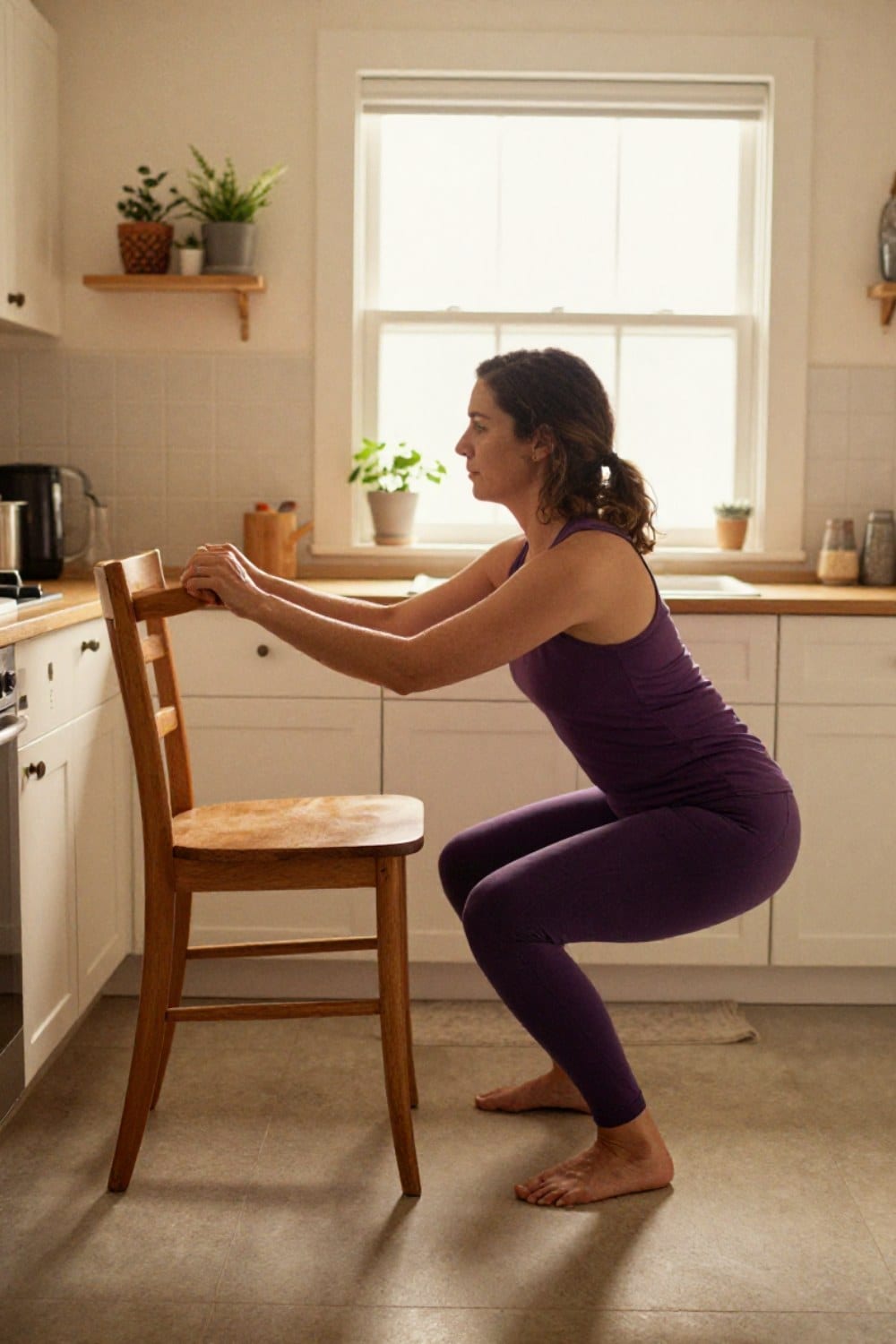
- Squat (sit-to-stand): Stand up from a sturdy chair without using your hands, then sit back down slowly. Add a light dumbbell at your chest once that's easy.
- Hinge: Hold a chair's back, push your hips back like you're closing a car door with them, and feel your hamstrings load. A band or dumbbell adds resistance once it feels natural.
- Push: Start with a wall push-up, move to hands on a counter, then a push-up with your hands on the floor.
- Pull: Loop a band around a sturdy door handle and row it toward your ribs, squeezing your shoulder blades together.
- Carry: Pick up something with real weight — a watering can, a dumbbell, a grocery bag — and walk a short distance holding it, one hand and then the other.
- Step: Step onto a stair or sturdy step stool, one leg at a time, holding a rail or chair back for balance at first.
That's it. Six moves, twice a week, progressing from bodyweight to a resistance band to a light dumbbell as each one gets easy — in that order, at whatever pace your own weeks allow.
How do you know it's heavy enough
This is the question that stops most beginners before they start, and the honest answer is simpler than it sounds. If you could easily do ten more reps than the plan asks for, it's too light. If you can't finish the set with good form, it's too heavy. You want the narrow, useful middle: the last two reps should take real, noticeable effort.
Walking and strength, together
If you're already following a walking plan, you don't need to reinvent your week to fit these two strength sessions in. We've already worked out how walking and strength fit together across seven days — read that before squeezing this in around an existing routine. This page is about the strength itself. That one is about the week.
Where this category goes from here
This starter plan is the anchor for everything else in Strength & Muscle After 40. A few places to go next, depending on what you need:
- Prefer bands to start? Resistance Band Workouts at Home goes deeper on band-only training.
- Ready for dumbbells? A Dumbbell Full-Body Workout is the natural next step.
- Want zero equipment? Bodyweight Strength Training After 40 covers this same plan with none.
- Wondering what's worth buying? The Best Home Strength Gear is an honest, no-pressure look.
- Haven't started walking yet? The free 4-week indoor walking plan is the easier place to begin.
Where this comes from
Every claim above is backed by one of these sources.
- 1It's Never Too Late: The Impact of Resistance Training on Strength and Body Composition in Females Across the Lifespan — A Systematic Review and Meta-Analysis
Journal of Science and Medicine in Sport · 2026
Supports: That a big 2026 review of 126 studies and roughly 4,000 women found no meaningful strength-gain difference by age or menopausal status.
- 2Sarcopenia: What It Is and What Causes It
Cleveland Clinic · 2024
Supports: That age-related muscle loss (sarcopenia) is real and well-documented, and accelerates around and after menopause.
- 3About Sarcopenia
Office on Women's Health, U.S. Department of Health and Human Services
Supports: That muscle mass naturally declines roughly 3-5% per decade starting around age 30, with menopause raising a woman's risk.
- 4Adult Activity: An Overview
CDC
Supports: That the CDC recommends muscle-strengthening activity on 2 or more days a week, working all major muscle groups.
- 5Optimal resistance training parameters for improving bone mineral density in postmenopausal women: a systematic review and meta-analysis
Journal of Orthopaedic Surgery and Research · 2025
Supports: That a review of 17 careful trials found training 3x/week at moderate-to-high intensity gave the most consistent bone-density gains at the spine and hip.
- 6Menopause Weight Gain Isn't Inevitable
Cleveland Clinic
Supports: That strength training with weights is recommended to help maintain and improve muscle mass through the menopause transition.
Free, and printable
The free 4-Week Indoor Walking Plan
The plan sign-up is not live yet — the mailing list is still being set up. In the meantime, email hello@strongandrooted.com and Diane will send it to you herself.
One email when there is something worth sending. Unsubscribe whenever you like.
Frequently asked questions
Am I too old to start strength training?
Do I need a gym membership or a full set of dumbbells to start?
Is it normal to be sore after these first sessions?
How is this different from the walking plan I've already started?
Two days a week. A kitchen chair. Two resistance bands. Six moves you can already half-picture yourself doing. That's genuinely the whole starting point. If the equipment side needs sorting, start with what's worth having at home. If bands alone sound like plenty for now, that's a complete path on its own. And if walking is still the piece you haven't started, the free plan is waiting, no cost. Pick one thing and do it on Tuesday.
Free, and printable
The 4-Week Indoor Walking Plan
The plan sign-up is not live yet — the mailing list is still being set up. In the meantime, email hello@strongandrooted.com and Diane will send it to you herself.
One email when there is something worth sending. Unsubscribe whenever you like.
Written by
Diane Marsh
At 49 I was tired, achy, sleeping badly, and being told to do more cardio and eat less — which was making all of it worse. I started walking. Fifteen minutes, indoors, in socks. Three years later I am stronger than I was at forty. I write down exactly what I did, cite the research where it exists, and admit where it doesn't.
Diane is not a doctor, a physical therapist, or a dietitian. She is a woman who rebuilt her own strength after perimenopause, reads the research carefully, cites it, and says so when nobody actually knows.
Keep reading
Bone is living tissue, and it responds to real load — that's the hopeful, honest mechanism behind this entire guide. Here's what the guidelines actually recommend for bone density after 40: the loading intensity almost nobody explains honestly, the real limits of walking and a weighted vest, and the one thing to skip entirely if you already have a diagnosis.
Strength & Muscle After 40: The Complete GuideAlmost nobody tells you the whole territory in one place — why it's not too late to build real strength after 40, what muscle actually protects (it was never about looks), the honest map of how to start, and the one safety rule that matters more than all the rest.
Bodyweight Strength Training After 40 (No Equipment, Anywhere)You don't need a gym bag, a suitcase of dumbbells, or a single new purchase to start building real strength after 40. Your own bodyweight is a genuine load — and your dining chair is a real squat rack. Here's the honest, no-equipment routine, and five ways to keep it working without adding a single pound.