Resistance Band Workouts at Home for Women Over 40
Bands are the least intimidating way into strength training — and for a beginner, that matters more than optimal. Here's an honest look at which band to buy, how to anchor it safely, and the full-body routine I'd actually give you to start with today.

By Diane Marsh··11 min read
Claims on this page are checked against the National Institute on Aging (NIH), Cleveland Clinic, the CDC and Mayo Clinic — all four are linked below.
General education, not medical advice. Talk to your doctor before starting something new.
The short version
- Two resistance bands — one loop, one tube with handles — are a complete strength setup to start with. No gym, no dumbbell rack required.
- A band keeps tension on the muscle through the whole movement, which is part of why so many beginners find it feels kinder on the joints than a dumbbell of similar difficulty.
- You can make the same band harder for months — shorten it, slow the tempo, pause at the hardest point — before you need a new one.
- Bands are a genuinely honest start, and dumbbells make it easier to track progress on paper. Both belong in the kit, eventually.
- The real risk is a worn or badly anchored band, not the exercise itself. Check yours for nicks, and stop for any sharp pain.
Two resistance bands and a kitchen chair. That is genuinely the whole entry price for real strength training at home — no membership, no equipment you have to learn to load, no room in the house you don't already have.
If a gym intimidates you, or a wall of dumbbells feels like a language you were never taught, bands are where I point almost every beginner first. Not because they're the lesser option you settle for. Because they're the one you'll actually pick up on an ordinary Tuesday, and that matters more than anything optimal.
If you're already walking regularly and wondering how strength fits around it, that weekly split is covered separately — this guide is about the strength itself: which band to get, how to anchor it so it won't slip, how to make it harder without buying anything new, and a full routine to start with today. It's also one piece of a bigger, honest introduction to strength training after 40, if you want the fuller picture first.
Why bands are such a forgiving place to start
A band doesn't need to be loaded, racked, or adjusted with a pin. It rolls into a drawer. It takes up less counter space than a fruit bowl. And because it has almost no learning curve, the actual barrier to starting today — not Monday, not once you've 'researched it more' — nearly disappears.
Here's the honest trade-off, and I'd rather tell you upfront than let you find out the hard way. Bands give you resistance that builds as you stretch them, so the load stays on the muscle through the whole movement, and a lot of beginners find that feels gentler on the joints than a dumbbell of similar difficulty. They also ask a little more of your balance and control, since the band doesn't sit in your hand the way a solid weight does.
Dumbbells have one real advantage bands don't: a clean number. You pick up the 10-pound pair instead of the 8s, and that's progress, decided and written down. A band doesn't hand you that number quite so cleanly — you're shortening it, slowing down, or pausing at the hardest point instead, and all of those genuinely count, but none of them look as tidy on paper.
That's not a reason to skip bands. It's why I want you to think of them as a great place to start, and a permanent tool in the kit — not the only tool you'll ever own. We'll come back to exactly when to add a simple dumbbell routine later in this guide.
Loop, tube, or long — what each band is actually for
Walk into the resistance-band aisle and you'll find three genuinely different tools wearing the same name.
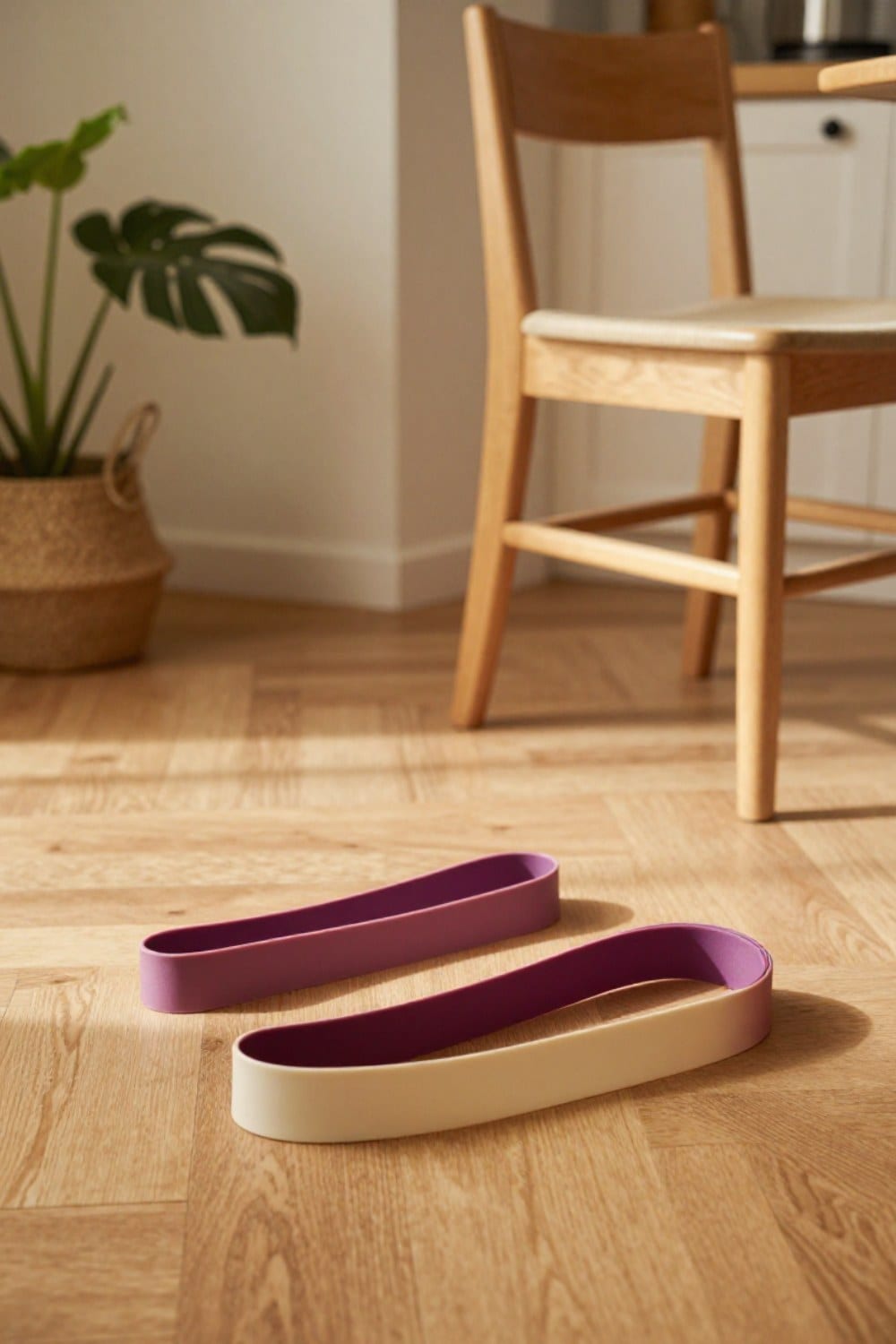
- Loop bands (small closed circles) — best for waking up your hips and glutes before a workout, and for adding resistance to squats, bridges and side steps you're already doing with just your body.
- Tube bands with handles — the closest thing to a dumbbell or a cable machine you'll find in this category. Rows, presses, curls, pulldowns — anything you'd normally reach for a weight to do.
- Long, flat bands (sometimes called therapy bands) — no handles, just length. Best for stretching, assisted moves, and wrapping around almost anything you need to anchor to.
You don't need all three on day one. One tube band with handles and one loop band cover almost everything in the routine further down this page.
How to anchor a band without buying anything extra
A band only works if the other end is going somewhere it won't move. Three ways to do that with what you already own:
- Over the top of a closed door — loop the band over the door itself (not the handle), close the door fully, and give it a firm tug before you lean any weight on it.
- Under one or both feet — stand on the band, hip-width apart, for rows, curls and presses. This is the simplest anchor there is, and it travels with you.
- Around a sturdy chair leg — for seated rows and presses. Check the chair won't slide on your floor before you commit your full effort to the movement.
One rule matters more than the other three: keep the anchor point at or below shoulder height for standing moves, and never at eye height. A band anchored up near your face has more room to snap back toward it if it slips, and there's no version of a home workout worth that risk.
Making a band harder without buying a new one
A band's resistance isn't fixed the way a dumbbell's weight is, and that's one of its underrated advantages. Before you buy a heavier one, you have at least three ways to make the exact band you already own feel harder:
- Shorten it. Stand further from the anchor, or choke up on the band with your hands — either one increases the tension at the same starting position.
- Slow the tempo. A four-count lowering phase on the same band, at the same length, is a noticeably harder set than a quick one.
- Pause at the hardest point. Hold for one or two seconds at the top of a row or the end of a press, right where the band is stretched the furthest, before you release.
Run through all three before you decide a band has stopped working for you. Most beginners have months of real progress left in two bands they already own.
A full-body band routine to start with
This is a genuine full-body session, not a warm-up. Do it two to three times a week, on non-consecutive days, with one tube band and one small loop band.
Your full-body band routine
Two sessions a week covers the baseline. A third is a bonus, never a requirement.
| Movement | Sets x reps | How it should feel | Easier option |
|---|---|---|---|
| Band squatStand on the band with both feet hip-width apart, handles at your shoulders. | 2 sets x 12 reps | Legs working by rep 10 — tired, not painful | Hold the back of a sturdy chair for balance |
| Standing band rowAnchor the band to a closed door at chest height. | 2 sets x 12 reps | Your upper back, between your shoulder blades, doing the work | Shorten the band less, or do the movement seated |
| Band chest pressAnchor the band behind you, at chest height. | 2 sets x 12 reps | A steady press through your chest and arms — no pinch in the shoulder | Press one arm at a time |
| Band hip hingeStand on the band and hinge at your hips with a soft bend in your knees. | 2 sets x 10 reps | The backs of your legs and your seat, not your lower back | Use a smaller range of motion, hands higher on the band |
| Band bicep curlStand on the band with both feet. | 2 sets x 12 reps | The front of your upper arm — nothing sharp, nothing in the joint | A shorter band, or fewer reps |
| Band glute bridgeLoop a band just above your knees, lying on your back. | 2 sets x 12 reps | Your outer hips and seat muscles switching on | Skip the band and just squeeze at the top of the bridge |
Muscle-strengthening work on at least two days a week, covering your major muscle groups, is the baseline most health guidance points to for real benefit — this routine is built to clear that bar in a single session.
So — are bands enough, or do you need dumbbells too?
Bands are enough for a genuinely long time. Combine the three progression tricks above with a slightly heavier band every few months, and you have a real, evolving strength program that doesn't require another purchase for most of a year.
Where bands start to show their ceiling is a long way down the road — once you've shortened them, slowed the tempo, and paused at the hardest point, and the exact same band still isn't challenging you. That's the honest signal to add a dumbbell full-body routine — not because the band failed you, but because you're ready for a tool that hands you a cleaner number to chase. If you're shopping for that next piece of gear, our honest home-strength-gear guide walks through what's actually worth adding, and when.
Where this comes from
Every claim above is backed by one of these five sources.
- 1How Can Strength Training Build Healthier Bodies as We Age?
National Institute on Aging (NIH)
Supports: That muscle mass and strength (sarcopenia) decline with age, and that resistance and strength exercise are the interventions shown to help protect against that decline.
- 2Sarcopenia: What It Is and What Causes It
Cleveland Clinic · 2024
Supports: That age-related muscle loss (sarcopenia) is a real, well-documented condition, and that resistance exercise is the intervention shown to help protect against it.
- 3Resistance Bands: Put Some Snap in Your Strength Training
Cleveland Clinic
Supports: That resistance-band training produces strength gains similar to conventional gym equipment, that bands keep tension on a muscle for longer during a movement, that shortening a band increases its resistance, and safety guidance on checking bands for wear and anchoring them securely before use.
- 4Adult Activity: An Overview
CDC
Supports: That muscle-strengthening activity covering all major muscle groups on 2 or more days a week is the baseline guideline for adults.
- 5Strength Training: Get Stronger, Leaner, Healthier
Mayo Clinic
Supports: That resistance bands are a safe, affordable, easy-to-use option for beginners starting strength training, and that all major muscle groups should be trained at least twice a week.
Free, and printable
The free 4-Week Indoor Walking Plan
The plan sign-up is not live yet — the mailing list is still being set up. In the meantime, email hello@strongandrooted.com and Diane will send it to you herself.
One email when there is something worth sending. Unsubscribe whenever you like.
Frequently asked questions
Are resistance bands actually enough to build muscle?
Which band should I start with — loop, tube, or long?
How do I anchor a band so it won't come loose or snap?
When should I add dumbbells if I'm already using bands?
Two bands, a door, and a kitchen chair are a complete strength setup for longer than most people expect. Start with the routine above, run through the progression tricks before you buy anything new, and when you're ready for the next step, a dumbbell routine and our home-gear guide are both waiting. For the full introduction to strength training after 40 — the why, not just the how — start here.
Free, and printable
The 4-Week Indoor Walking Plan
The plan sign-up is not live yet — the mailing list is still being set up. In the meantime, email hello@strongandrooted.com and Diane will send it to you herself.
One email when there is something worth sending. Unsubscribe whenever you like.
Written by
Diane Marsh
At 49 I was tired, achy, sleeping badly, and being told to do more cardio and eat less — which was making all of it worse. I started walking. Fifteen minutes, indoors, in socks. Three years later I am stronger than I was at forty. I write down exactly what I did, cite the research where it exists, and admit where it doesn't.
Diane is not a doctor, a physical therapist, or a dietitian. She is a woman who rebuilt her own strength after perimenopause, reads the research carefully, cites it, and says so when nobody actually knows.
Keep reading
Bone is living tissue, and it responds to real load — that's the hopeful, honest mechanism behind this entire guide. Here's what the guidelines actually recommend for bone density after 40: the loading intensity almost nobody explains honestly, the real limits of walking and a weighted vest, and the one thing to skip entirely if you already have a diagnosis.
Strength & Muscle After 40: The Complete GuideAlmost nobody tells you the whole territory in one place — why it's not too late to build real strength after 40, what muscle actually protects (it was never about looks), the honest map of how to start, and the one safety rule that matters more than all the rest.
Bodyweight Strength Training After 40 (No Equipment, Anywhere)You don't need a gym bag, a suitcase of dumbbells, or a single new purchase to start building real strength after 40. Your own bodyweight is a genuine load — and your dining chair is a real squat rack. Here's the honest, no-equipment routine, and five ways to keep it working without adding a single pound.