Bodyweight Strength Training After 40 (No Equipment, Anywhere)
You don't need a gym bag, a suitcase of dumbbells, or a single new purchase to start building real strength after 40. Your own bodyweight is a genuine load — and your dining chair is a real squat rack. Here's the honest, no-equipment routine, and five ways to keep it working without adding a single pound.

By Diane Marsh··11 min read
Claims on this page are checked against Cleveland Clinic, the National Institute on Aging (NIH), the CDC, Harvard Health and a peer-reviewed sports-science journal — all five are linked below.
General education, not medical advice. Talk to your doctor before starting something new.
The short version
- Your own bodyweight is a real load — standing up from a dining chair without using your hands is a genuine squat, not a warm-up for one.
- Five ways make bodyweight harder without adding a single pound: change the leverage, slow the tempo, pause at the bottom, go single-leg, or add reps.
- This is a complete way to train for months, and a permanent option for any week without equipment — travel, a small space, or the week you can't face buying anything.
- Bodyweight strength has an honest ceiling. Once it stops feeling like enough, resistance bands or a light pair of dumbbells are the natural next step — not a sign this page failed you.
- Sharp or joint pain means stop and check with your own doctor or a physical therapist. Sore isn't the same thing as hurt.
Some weeks, buying anything new just isn't going to happen. Maybe you're folded into a hotel room the size of a closet. Maybe you're staying at your daughter's for a week to help with a new baby, and your suitcase has zero room for a resistance band, let alone a dumbbell. Maybe you're not away at all — you're just tired, and ordering one more piece of equipment feels like its own small chore. This page is for that week, and honestly, for most of the ordinary weeks around it too.
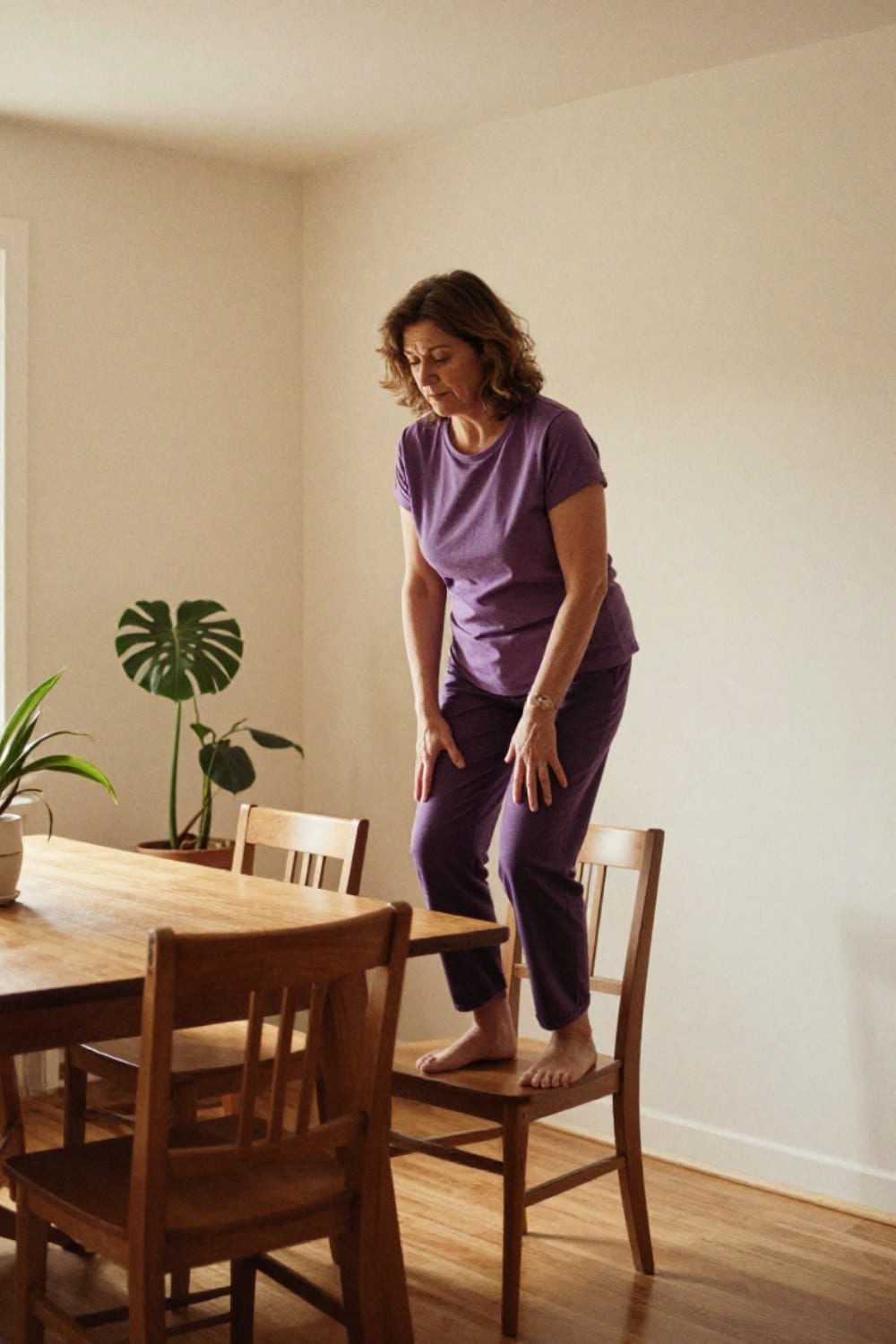
Here's the part worth saying plainly: your own bodyweight is a real load. It isn't a warm-up for the actual workout, and it isn't a lesser option until you can afford the real equipment. When you stand up out of a dining chair without rocking or grabbing the table for help, you are moving your entire bodyweight against gravity. That is a genuine squat. Your dining chair is a squat rack you already own, sitting in your kitchen right now.
This page is the zero-equipment piece of a bigger picture — our full beginner strength training guide covers the whole roadmap, bands and dumbbells included. If you already have a walking habit going, the two-part week shows how walking and strength fit together. This page goes deep on just one piece: no equipment at all, anywhere, for as long as that's true.
Why this matters after 40
Muscle doesn't announce when it starts leaving — just a slow decline that starts earlier than most women expect. Cleveland Clinic notes that adults can lose as much as eight percent of their muscle mass per decade, starting in their thirties and forties. Resistance work — bodyweight fully included — is what the National Institute on Aging points to as the intervention shown to help protect against that decline. How much is enough? The CDC's baseline is muscle-strengthening activity at least twice a week, working every major muscle group. The routine further down this page, done two or three times a week, comfortably clears that bar.
Bodyweight training is a real workout, not a lesser one
Bodyweight training gets dismissed a lot, mostly because it's free and doesn't come with a receipt. But free and ineffective aren't the same thing. A body moving its own weight through a real range of motion, to the point where the next rep is genuinely hard, is doing real strength work — the same basic stimulus a dumbbell provides, just delivered differently.
The honest ceiling — and why that's fine for now
Here's the part a lot of no-equipment articles skip. Bodyweight training has a real limit. Once twenty controlled chair squats or a two-minute plank feel easy, your own weight stops being enough to keep building strength efficiently — the same way lifting a five-pound weight forever eventually stops doing much. That's not this page failing you; it's your body doing exactly what consistent training is supposed to do.
For months before that point, bodyweight is a complete way to train, not a partial one. And for any week when equipment genuinely isn't an option — travel, a shared guest room, the week you just don't have it in you to shop — it's a permanent plan to come back to.
Five ways to make bodyweight harder without adding a single pound
Here's the actual toolkit. Five ways to keep asking more of your body, none of which cost a cent.
- Change the leverage. An incline push-up with hands on a kitchen counter is easier than one with hands on a low coffee table, which is easier than one with hands on the floor — no new equipment, just a lower angle.
- Slow the tempo. Take three or four seconds lowering into a squat and the same coming back up. The move looks identical from across the room — it feels considerably harder.
- Pause at the bottom. A two- or three-second dead stop at the bottom of a squat or push-up removes the small bounce that usually helps you out — all the work comes from muscle, not momentum.
- Go single-leg. A two-legged sit-to-stand becomes a single-leg-assisted stand — one leg doing most of the work — and eventually a fuller single-leg squat. Working one side at a time roughly doubles the demand without adding an ounce.
- Add reps, then sets. Once a move feels genuinely easy for twelve to fifteen slow reps, doing more — and eventually a second or third round — is a completely legitimate way to keep progressing, not a consolation prize for skipping a dumbbell.
Any one of these, used on its own, keeps a familiar move useful for weeks. Here's what the research specifically says about whether that actually adds up to real strength.
The routine: one full-body session, anywhere
Six moves, no equipment, done anywhere there's a sturdy chair and enough floor to lie down on. Two or three rounds through this list is a complete session. Three sessions a week, with a walk or rest day between them, is a solid place to start.
Your no-equipment full-body routine
Two or three rounds through this list, resting whenever you need to. That's the whole session.
| Move | Sets x reps | How it should feel | Easier version |
|---|---|---|---|
| Chair sit-to-standThe entire first week can be just this move, done slowly and well. | 2–3 sets x 8–12 | Legs working by the last few reps — like carrying one extra grocery bag | Keep a hand on the seat or armrests, or use a taller, firmer chair |
| Incline push-up | 2 sets x 8–12 | Chest and arms working; shoulders should stay comfortable, never pinching | Hands on a kitchen counter or sturdy table instead of the floor |
| Standing hip hinge | 2 sets x 10–12 | A stretch down the back of your legs, a light squeeze at the top | Bend your knees more and hinge through a smaller range |
| Chair-supported split squat | 2 sets x 6–8 per side | Front leg working hard by the last couple of reps | Shorten the range and keep both hands on the chair the whole time |
| Plank or modified hold | 2–3 holds x 15–30 seconds | Core and shoulders working to keep you steady, no sagging through the middle | From your knees instead of your toes, or lean into a counter at an incline |
| Carry, anywhereA full water jug, a stuffed duffel bag, or a couple of hardcover books all work fine. | 1–2 trips x 30–60 seconds | Grip and posture working to stay tall while you move | Carry one lighter item in one hand instead of two |
Please be careful
When bodyweight stops being enough
If you keep at this for a few months, there's a good chance the six moves above, done well, will stop feeling like much of a challenge. That's not a flaw in the plan — it's the plan working exactly as long as it's supposed to. Many bodies eventually need real external resistance to keep progressing efficiently.
When that day comes, two resistance bands are the smallest, most travel-friendly next step — here's a full at-home band routine using moves you already know. A light pair of dumbbells covers what bands can't quite replicate — here's a three-day dumbbell routine for when you're ready. Neither replaces this page — keep it bookmarked regardless. It's the version that packs in a suitcase and asks for nothing extra.
None of this is about your specific body — only about what's actually documented about muscle, bodyweight training, and progression, cited plainly below.
Where this comes from
Every claim above about muscle, aging and bodyweight progression traces to one of these five.
- 1Sarcopenia: What It Is and What Causes It
Cleveland Clinic · 2024
Supports: That age-related muscle loss (sarcopenia) is real and well documented, and that adults can lose as much as 8% of their muscle mass per decade starting in their 30s and 40s.
- 2How Can Strength Training Build Healthier Bodies as We Age?
National Institute on Aging (NIH)
Supports: That resistance and strength exercise — using any genuine form of resistance, bodyweight included — are the interventions shown to help protect against age-related muscle and strength decline.
- 3Adult Activity: An Overview
CDC
Supports: That muscle-strengthening activity at least twice a week, working all major muscle groups, is the baseline recommendation for adults, with no requirement that resistance come from a gym or free weights.
- 4No Equipment Necessary
Harvard Health
Supports: That bodyweight training can produce results comparable to using weights and machines, and that varying pace, position and speed is a legitimate way to increase intensity.
- 5Effect of Progressive Calisthenic Push-up Training on Muscle Strength and Thickness
Journal of Strength and Conditioning Research · 2018
Supports: That a four-week program of progressively harder push-up variations produced measurable strength gains comparable to a traditional bench-press program, though muscle-thickness change did not show a clear difference in either group in that short trial.
Free, and printable
The free 4-Week Indoor Walking Plan
The plan sign-up is not live yet — the mailing list is still being set up. In the meantime, email hello@strongandrooted.com and Diane will send it to you herself.
One email when there is something worth sending. Unsubscribe whenever you like.
Frequently asked questions
Can you actually build muscle with no equipment after 40?
Is standing up from a dining chair really a workout?
My wrists or knees bother me during these moves — do I need to skip them?
How will I know when it's time to add resistance bands or dumbbells?
Your own bodyweight, a sturdy chair, and twenty minutes, three times a week — that's the entire plan, no purchase required. For the fuller roadmap this fits into, start with our beginner strength training guide. Already walking? Here's how the two fit together. And whenever this stops feeling like enough — because for a lot of women, that day comes — resistance bands or a simple dumbbell routine are the honest next step. For today, just find a sturdy chair.
Free, and printable
The 4-Week Indoor Walking Plan
The plan sign-up is not live yet — the mailing list is still being set up. In the meantime, email hello@strongandrooted.com and Diane will send it to you herself.
One email when there is something worth sending. Unsubscribe whenever you like.
Written by
Diane Marsh
At 49 I was tired, achy, sleeping badly, and being told to do more cardio and eat less — which was making all of it worse. I started walking. Fifteen minutes, indoors, in socks. Three years later I am stronger than I was at forty. I write down exactly what I did, cite the research where it exists, and admit where it doesn't.
Diane is not a doctor, a physical therapist, or a dietitian. She is a woman who rebuilt her own strength after perimenopause, reads the research carefully, cites it, and says so when nobody actually knows.
Keep reading
Bone is living tissue, and it responds to real load — that's the hopeful, honest mechanism behind this entire guide. Here's what the guidelines actually recommend for bone density after 40: the loading intensity almost nobody explains honestly, the real limits of walking and a weighted vest, and the one thing to skip entirely if you already have a diagnosis.
Strength & Muscle After 40: The Complete GuideAlmost nobody tells you the whole territory in one place — why it's not too late to build real strength after 40, what muscle actually protects (it was never about looks), the honest map of how to start, and the one safety rule that matters more than all the rest.
Strength Training for Beginners Over 40: The Honest Starter PlanAlmost nobody tells her the encouraging part: postmenopausal women build strength just as effectively as women who haven't reached menopause yet. Here's the honest starter plan — two days a week, a kitchen chair, two bands, six moves — and the real research behind why it's genuinely not too late.