A Dumbbell Full-Body Workout for Women Over 40 (3 Days a Week)
You've done the bands for a few weeks now, and here's the honest next question: is it time for something with real weight behind it? This is the three-day-a-week dumbbell session I'd actually give a friend — five compound moves, thirty to forty-five minutes, and the one move almost nobody expects to be the most useful.

By Diane Marsh··11 min read
Claims on this page are checked against Cleveland Clinic, the National Institute on Aging (NIH), the CDC, and a 2025 peer-reviewed bone-density review of the research — all linked below.
General education, not medical advice. Talk to your doctor before starting something new.
The short version
- This is a three-day-a-week, five-move dumbbell session — squat, hinge, press, row and carry — done in thirty to forty-five minutes.
- The floor is two strength days a week per the CDC; a 2025 review found three days a week was the sweet spot for bone-density gains in postmenopausal women.
- Pick your weight honestly: the last two reps of every set should be hard, but your form should stay clean. Breezing through all twelve reps means it's time to go up.
- The farmer's carry — walking while holding two dumbbells — is the single most underrated move in this whole session.
- Soreness a day or two later is normal. Sharp or joint pain means stop, and that's a conversation for your own doctor or a physical therapist, not this page.
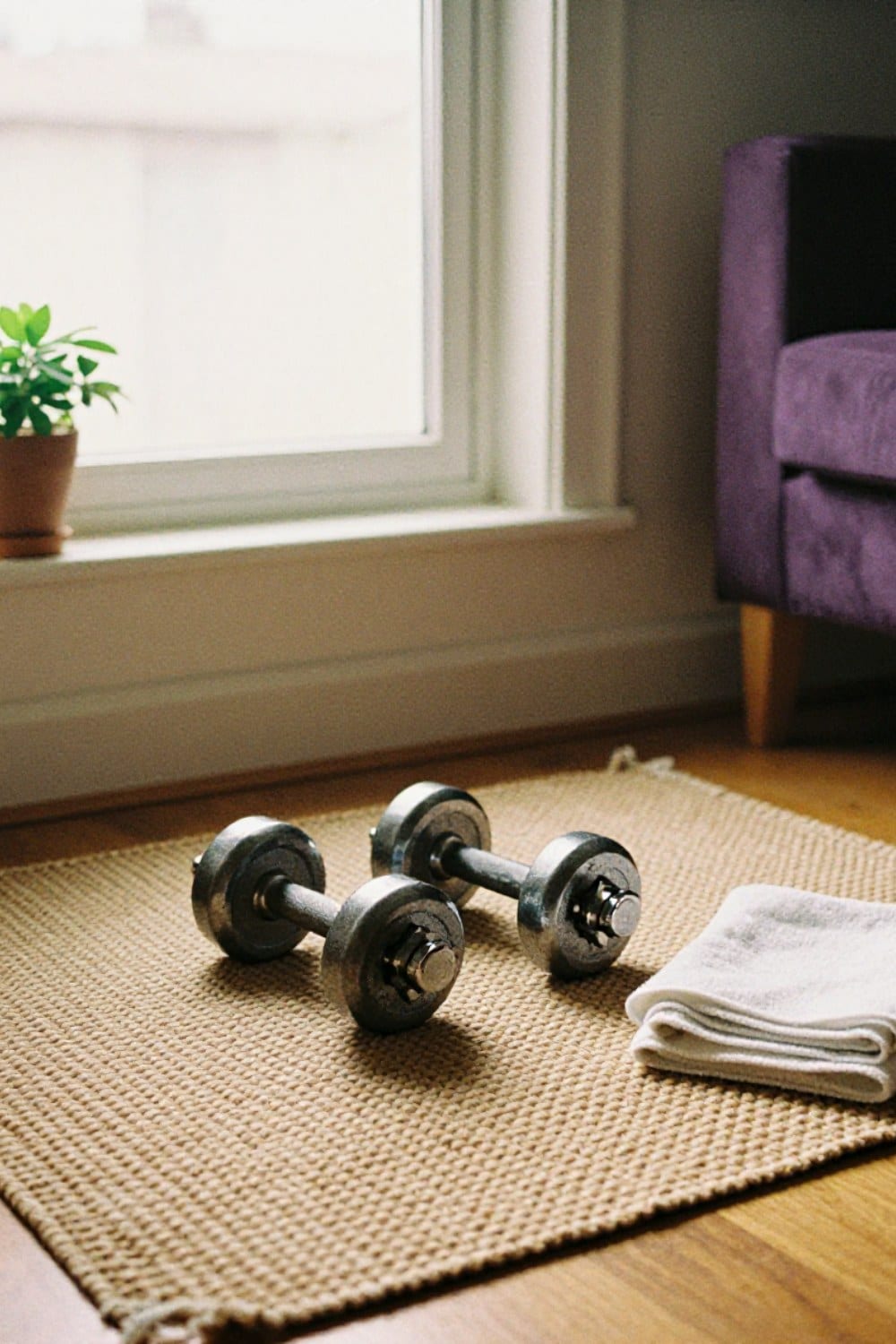
Say the word "dumbbells" to a lot of women over 40 and the picture that shows up isn't a living room — it's a gym floor, a rack of intimidating iron, and someone three decades younger grunting through a set next to a mirror. That's not what this is. This is two dumbbells, a patch of rug the size of a bath mat, and thirty to forty-five minutes in your own home, three days a week.
If you've spent the last few weeks with two resistance bands and a kitchen chair — and if that's new to you, that's exactly the right place to have started — here's the honest next question: is it time for something with a little more weight behind it?
This is the session I'd actually hand a friend who's ready for that step. Five compound moves — a squat, a hinge, a press, a row and a carry — done in your living room with nothing else required. This page covers those exercises specifically: what to do, how much, and how to tell if you've picked the right weight. If you haven't read it yet, the full beginner's guide to strength training over 40 is the wider map this page fits into.
Why Move Up From Bands at All
Bands are genuinely useful, and there's no rule that says you have to graduate from them — plenty of women stay with bands for years and do just fine. But somewhere in your thirties, and more noticeably from your forties on, your body starts quietly setting down a little muscle every year, a trend that tends to speed up further once perimenopause and menopause are underway.
A resistance band gets harder the further you stretch it, but the load it offers has a ceiling — and for a lot of women, that ceiling arrives faster than expected, sometimes within a few weeks of consistent use. A dumbbell doesn't have that limit. You can always pick up a heavier one next month. That headroom is most of the reason to make the switch.
It matters even more for bone. Bands can absolutely build muscle, but bone tends to respond best to a heavier, more direct load pressing down through it — which is where a pair of dumbbells starts to do something bands alone typically can't.
Why Three Days a Week (Not Two, Not Seven)
The floor here is well established: the CDC recommends muscle-strengthening activity on at least two days a week, hitting all the major muscle groups — legs, hips, back, abdomen, chest, shoulders and arms. Two honest sessions a week, done with good form, already clears that bar. If two is genuinely all your week has room for right now, two is real, and it counts.
Three appears to be where an extra benefit shows up, at least for bone. A 2025 review of the research on postmenopausal women found that resistance training performed at least three times a week, at a load heavy enough to feel like genuine effort, produced the most consistent bone-density gains at the spine, hip and femoral neck — the same bone thread we've written about with walking. Two days is a real, worthwhile floor. Three appears to be where bone responds best.
None of that means seven is better than three. Muscle rebuilds on rest days, not during the set itself, and a body that never rests tends to collect overuse aches instead of extra strength. Three sessions with real rest between them is the plan, not a compromise version of a better one.
The Session
Here's the whole thing: five moves, done in this order, on any three non-consecutive days a week.
Your 3-day dumbbell session
Five moves, done in this order, on any three non-consecutive days a week. Rest a beat between sets — enough to catch your breath, not enough to cool down completely.
| Exercise | Sets x Reps | How It Should Feel | Easier Option |
|---|---|---|---|
| Goblet Squat | 2-3 sets x 10-12 reps | Your thighs and hips do the work; the last couple of reps take real focus to finish with clean form | Squat down to a sturdy chair seat, tap it lightly, and stand back up |
| Dumbbell Hinge (Romanian Deadlift) | 2-3 sets x 8-10 reps | A stretch down the back of your legs — if your lower back is what's talking, the hinge is too deep or the weight is too heavy | Hold one dumbbell with both hands and hinge only as far as feels comfortable |
| Dumbbell Press (Overhead or Floor) | 2-3 sets x 8-12 reps | Your shoulders and arms are genuinely tired by the last rep, ribs stacked over hips, not flared open | Press lying on the floor instead of overhead — a shorter range that takes your lower back out of it entirely |
| Bent-Over Row | 2-3 sets x 10-12 reps | A pulling, squeezing feeling between your shoulder blades, not your lower back | Rest your free hand and knee on a sturdy chair and row one arm at a time |
| Farmer's Carry | 2-3 rounds x 20-40 seconds (or one hallway length) | Your grip gives out before your legs do — that's normal, and it's the whole point | Carry one dumbbell at a time, switching arms halfway, or shorten the distance |
No dumbbells today, or packing for a trip? The bodyweight version of this same session covers the same five movement patterns without any equipment at all.
Picking a Weight You Can Be Honest About
This is where most beginners either quit from frustration or coast for months without much to show for it, and it's almost always the same mistake, just pointed in opposite directions: too heavy, and the first week wrecks your motivation and your form both. Too light, and week six looks exactly like week one.
The honest test is simple. If you can finish all twelve reps of a set without the last two feeling like real effort, the weight is too light — go up next session. If your form falls apart, your lower back rounds, or you can't finish the set at all, it's too heavy — go down today, not next week. Neither adjustment is a failure. It's just information.
Expect the right weight to differ move to move, and don't let that surprise you. Most women press or row more easily than they hinge or squat on day one — a lighter pair for the row and a heavier one for the squat is normal, not a sign you're doing it wrong.
If you don't own dumbbells yet, here's an honest look at what's actually worth having at home — you need less variety than the internet makes it look like, usually just one adjustable pair that covers all five moves.
What Progress Actually Looks Like, Week to Week
Progressive overload is a stiff way of saying something simple: ask your muscles for slightly more than they're used to, and they adapt. In practice, that looks smaller than people expect. Week one might be two sets of eight reps at a manageable weight. By week three, it's three sets of ten at the same weight. Once all three sets of twelve feel clearly doable with good form, that's the week you add weight — and drop back to eight or ten reps at the new one.
That's the entire system. No app, no percentage math, nothing more complicated to track than "did the last two reps feel hard, or easy." Some weeks you won't feel ready to add anything at all, and that's a completely normal week, not a failed one — strength built slowly is still strength built.
The Farmer's Carry Is the Most Underrated Thing in This Session
Of the five moves, the one almost nobody expects to matter is the last one: pick up two dumbbells, stand tall, and walk. That's the entire exercise, start to finish, and it's doing more than it looks like it's doing.
A farmer's carry asks your grip, shoulders, core and posture to hold steady all at once, under real load, for time — a close copy of carrying two grocery bags in one trip, hauling a laundry basket up the stairs, or wrangling a suitcase through an airport. Most of the other four moves train one clear pattern each. The carry trains the skill of simply staying upright and strong while holding something heavy — the one thing daily life actually asks of you, over and over, without ever calling it exercise.
Where this comes from
Every claim above is backed by one of these five sources.
- 1Sarcopenia: What It Is and What Causes It
Cleveland Clinic · 2024
Supports: That adults can lose as much as 8% of their muscle mass per decade starting in their thirties and forties, a decline that accelerates further in later decades.
- 2How Can Strength Training Build Healthier Bodies as We Age?
National Institute on Aging (NIH)
Supports: That resistance and strength exercise are the interventions specifically shown to help protect against age-related muscle and strength decline.
- 3Adult Activity: An Overview
CDC
Supports: That the baseline recommendation for adults is muscle-strengthening activity on two or more days a week, covering all major muscle groups, performed to a point where another repetition without help would be hard.
- 4Optimal Resistance Training Parameters for Improving Bone Mineral Density in Postmenopausal Women: A Systematic Review and Meta-Analysis
Journal of Orthopaedic Surgery and Research · 2025
Supports: That in a 2025 review of careful trials, resistance training performed at least three times a week at higher intensity produced the most consistent bone-mineral-density improvements at the spine, hip and femoral neck in postmenopausal women.
- 5What To Know About Menopause and Bone Loss
Cleveland Clinic
Supports: That bone density can decline significantly in the years around menopause as estrogen drops, and that weight-bearing and strength exercise is a recommended way to help protect it.
Free, and printable
The free 4-Week Indoor Walking Plan
The plan sign-up is not live yet — the mailing list is still being set up. In the meantime, email hello@strongandrooted.com and Diane will send it to you herself.
One email when there is something worth sending. Unsubscribe whenever you like.
Frequently asked questions
How heavy should my dumbbells be?
What if I don't have dumbbells at home yet?
Do I still need to walk if I'm doing this?
I'm sore for two days after a session — is that normal, or did I overdo it?
Five moves, three days, thirty to forty-five minutes — that's the whole session, and it doesn't need to be more complicated than that. If you're not ready for dumbbells yet, start with two resistance bands instead; the patterns are the same, just at a gentler load. No dumbbells on a travel week? The bodyweight version covers the same five movements with nothing but a floor. And if you haven't read it yet, the full beginner's guide to strength training over 40 is where this whole category starts. For today, though: two dumbbells, a rug, and half an hour is enough.
Free, and printable
The 4-Week Indoor Walking Plan
The plan sign-up is not live yet — the mailing list is still being set up. In the meantime, email hello@strongandrooted.com and Diane will send it to you herself.
One email when there is something worth sending. Unsubscribe whenever you like.
Written by
Diane Marsh
At 49 I was tired, achy, sleeping badly, and being told to do more cardio and eat less — which was making all of it worse. I started walking. Fifteen minutes, indoors, in socks. Three years later I am stronger than I was at forty. I write down exactly what I did, cite the research where it exists, and admit where it doesn't.
Diane is not a doctor, a physical therapist, or a dietitian. She is a woman who rebuilt her own strength after perimenopause, reads the research carefully, cites it, and says so when nobody actually knows.
Keep reading
Bone is living tissue, and it responds to real load — that's the hopeful, honest mechanism behind this entire guide. Here's what the guidelines actually recommend for bone density after 40: the loading intensity almost nobody explains honestly, the real limits of walking and a weighted vest, and the one thing to skip entirely if you already have a diagnosis.
Strength & Muscle After 40: The Complete GuideAlmost nobody tells you the whole territory in one place — why it's not too late to build real strength after 40, what muscle actually protects (it was never about looks), the honest map of how to start, and the one safety rule that matters more than all the rest.
Bodyweight Strength Training After 40 (No Equipment, Anywhere)You don't need a gym bag, a suitcase of dumbbells, or a single new purchase to start building real strength after 40. Your own bodyweight is a genuine load — and your dining chair is a real squat rack. Here's the honest, no-equipment routine, and five ways to keep it working without adding a single pound.