The Best Home Strength Gear for Women Over 40 (An Honest Short List)
Here's the truth before the shopping list: a kitchen chair and your own body weight are a real workout, and you can start today with neither. If you're going to buy something anyway, here's the genuinely short list — five items, in the order they're worth owning, chosen for fit and function, not hype.

By Diane Marsh··10 min read
Claims on this page about strength-training progression and frequency are checked against Mayo Clinic, Cleveland Clinic, the National Institute on Aging (NIH) and the CDC — all four are linked below.
This post contains affiliate links. As an Amazon Associate I earn from qualifying purchases — at no extra cost to you.
General education, not medical advice. Talk to your doctor before starting something new.
The short version
- You need almost none of this to start — a kitchen chair and your own body weight are a complete beginner routine.
- If you do buy, the order matters: bands, then adjustable dumbbells, then a door anchor, a mat, and a step — in that order, not all at once.
- Small weight increments matter more than a heavy top end — big jumps between sizes are a common, honest reason women quit.
- Fit, comfort and whether you'll actually use it again in March matter more than any spec on the label.
- This list tops out at five items. If a piece of gear needs its own room, it isn't a beginner purchase.
Let's start with the honest part, before a single product shows up on this page: you do not need any of this to get stronger. A sturdy kitchen chair and your own body weight are a complete beginner strength workout, and the full beginner plan shows how — sit-to-stands, wall push-ups, standing marches, nothing purchased.
If you'd rather start with zero shopping at all, the bodyweight-only version of this same plan covers every major muscle group using nothing but a wall, a floor and a chair. Read that one first if 'do I need to buy something to begin' is the actual question keeping you from starting.
This page exists for the honest next question: once bodyweight starts feeling easy, what's worth buying? Not a list built to sell you everything at once — a short list, in the order it's worth owning, built around fit, comfort, and whether you'll reach for it again in March.
Most gear guides for this topic spend their time comparing specs and stock numbers. This one doesn't, on purpose. What predicts whether a piece of equipment earns a permanent spot in your week has little to do with any of that, and a lot to do with whether it fits your hand, your joints, your living room, and your actual Tuesday.
What you need to start: nothing
Say it plainly, because most of this industry won't: a beginner strength routine built entirely around a chair and your own body weight is a real, complete workout. It isn't a lesser version of 'real' training while you wait to buy equipment — it's the actual first stage of the plan, for as many weeks as you want to stay there.
If you're going to buy: the short list, in order
When bodyweight moves do start feeling easy — usually somewhere past the point where the bodyweight plan stops feeling like enough of a challenge — here's the order I'd actually buy in, and why the order matters more than the list itself. Buying all five at once tends to mean four of them sit in a closet; buying in order tends to mean you use all five.
The buying order
Same five categories, in the order they're actually worth owning.
| Priority | Get this | What it unlocks |
|---|---|---|
| 1stStill optional. The bodyweight plan works without this; a band just adds resistance once bodyweight alone stops being enough. | Loop or tube resistance bands | Every major muscle group at once, gentle enough to learn real form on — the highest-value purchase if you only make one. |
| 2ndWait until band moves feel easy most weeks. Dumbbells reward a base you've already built; they don't build it for you. | Adjustable dumbbells | A visible number to add to — the purchase that actually changes what's possible, because progress stops being a guess. |
| 3rdA small piece of hardware that multiplies everything you already own — buy it with the bands, or right after. | A door anchor | Turns one band into a row, a press and a pull-apart instead of just the two or three moves a loose band allows. |
| 4thWorth having before you need it — bare knees on a bare floor get old fast. | A non-slip exercise mat | A stable, cushioned surface for floor work and kneeling moves — the difference between comfortable and distracting. |
| 5thThe most skippable item here if space is tight. A solid staircase step does most of the same job. | A sturdy step or bench | A stable platform for split squats and step-ups — the one everyday-strength move a flat floor genuinely can't provide. |
| Not on this listIf a piece of gear needs a dedicated room, it isn't a beginner purchase — it's a hobby for later, and that's fine. | A squat rack, a full weight-plate tree, a smart mirror, anything that needs its own room | Nothing. This entire plan tops out at five items and a chair you already own. |
Buying criteria for a midlife body
Every item on that list gets judged against the same five questions before it earns a spot — not by how it looks in a photo.
- Fit in the hand. A handle or grip sized for a smaller hand matters more than any other spec on a band or a dumbbell.
- Knurling that isn't harsh. The textured grip on a dumbbell should feel solid against your palm, not like sandpaper after five reps.
- Small weight jumps. The gap between one setting and the next should be small enough to actually climb — a jump that's too big is a common, honest reason women quit.
- Storage in a real home. If it doesn't have an obvious spot in your actual living space, it will live on the floor, then in a closet, permanently.
- Whether you'll actually use it. The unglamorous truth: the best piece of gear is the one that's still out of the closet in March.
Please be careful
The short list
Here's the list itself — six listings across the five categories above, chosen for fit and function. None of it requires a specific brand; compare current listings and reviews yourself, since what's in stock shifts.
Six items across five categories — bands, dumbbells, a door anchor, a mat, and a step.
| What it is | Best for | Why I'd pick it |
|---|---|---|
| Loop Resistance Bands (Set of Several Strengths) A few different strengths in one set means you're not stuck at one resistance the day the lightest band stops being enough. | Chair-based leg and glute work, plus full-body moves that travel with you | A few different strengths in one set means you're not stuck at one resistance the day the lightest band stops being enough. |
| Tube Resistance Bands with Handles Handles are kinder to your grip than a flat loop for a row or a press. | Rows, presses and anything that mimics a dumbbell move | Handles are kinder to your grip than a flat loop for a row or a press. |
| Adjustable Dumbbells One adjustable pair replaces a shelf of fixed weights, and the small jump between sizes is the entire point — more on that above. | Progress you can actually see and add to, a little at a time | One adjustable pair replaces a shelf of fixed weights, and the small jump between sizes is the entire point — more on that above. |
| Over-the-Door Resistance Band Anchor Turns a single band into a row, a press and a pull-apart, instead of just the two or three moves a loose band allows on its own. | Turning one band into a dozen different pulling angles | Turns a single band into a row, a press and a pull-apart, instead of just the two or three moves a loose band allows on its own. |
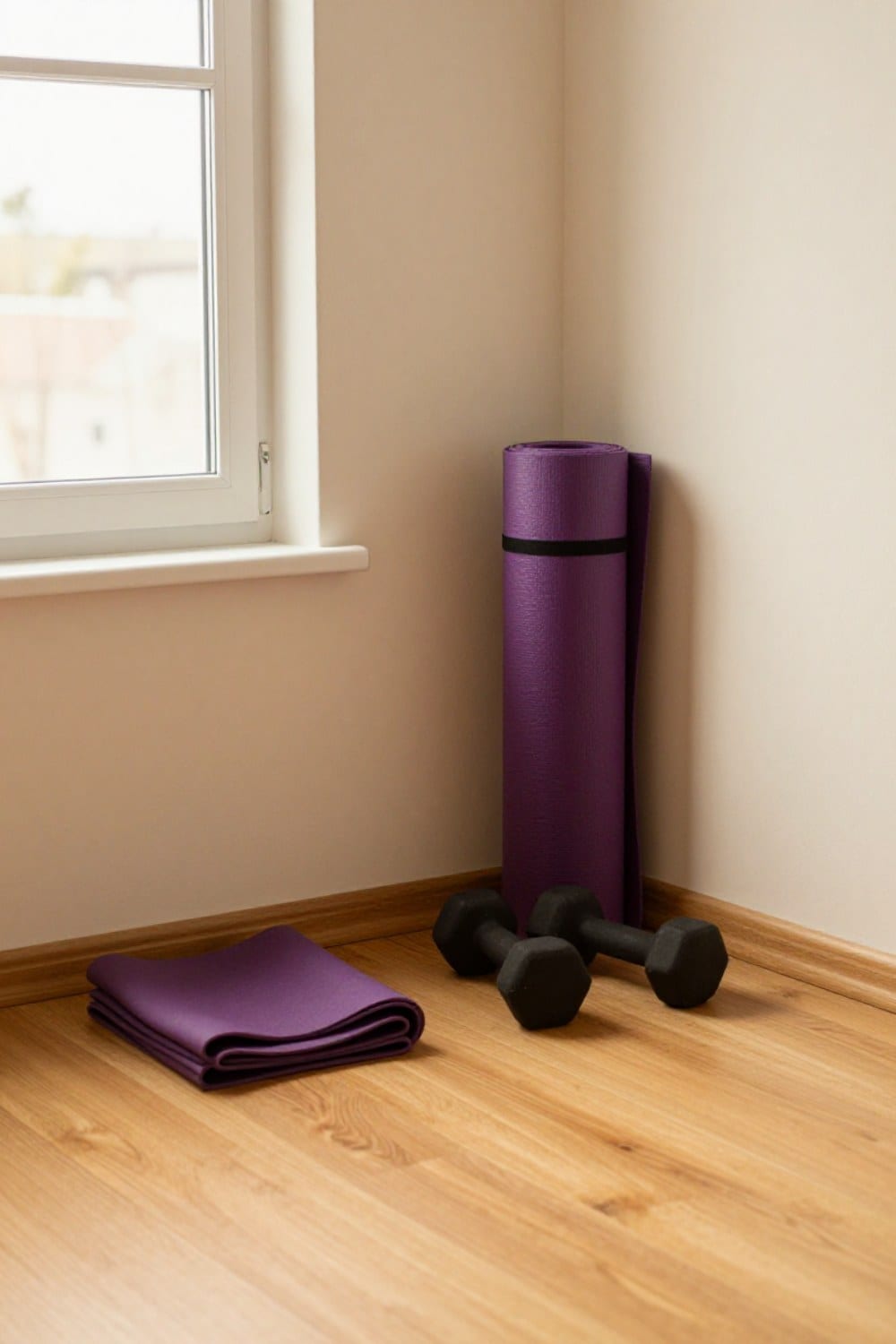
| Non-Slip Exercise Mat This is the simplest comfort upgrade on the whole list, and the one you'll notice missing fastest on an achy-joint day. | Floor work, kneeling moves, and protecting wrists and knees from a hard floor | This is the simplest comfort upgrade on the whole list, and the one you'll notice missing fastest on an achy-joint day. |
| Adjustable Step Platform or Bench A stable platform is what makes a step-up or a split squat feel controlled instead of wobbly. | Split squats, step-ups, and elevated push-ups | A stable platform is what makes a step-up or a split squat feel controlled instead of wobbly. |
No prices here — Amazon requires them to be live, so click through to see what something costs today. Equipment helps; it is never the thing that makes a plan work.
Loop Resistance Band Set
If you buy exactly one thing off this entire page, make it this — every major muscle group, no learning curve, and it fits in a kitchen drawer.
See it on Amazon →Adjustable dumbbells: the one purchase that actually changes things
Of the five items here, adjustable dumbbells are the one that changes what's actually possible, not just what's comfortable. A band's resistance is real, but it's approximate — it's hard to know exactly how much changed when you shorten your grip or double up a loop. A dumbbell gives you an actual number, and a number is something you can build a plan around and watch move over months. Here's the full-body dumbbell workout built specifically around a single adjustable pair, three days a week.
Bands, specifically: what to do with them
A band set by itself is just a length of rubber until you know what to do with it. Our full resistance-band routine walks through the rows, presses and pull-aparts that turn one band and a door anchor into a complete session — the natural next step once the list above actually gets you the gear.
Where this actually lives in a real home
Storage isn't a minor detail — it's the difference between gear you use and gear you store. Every item on this list needs an obvious spot you'll actually walk past: a drawer, a closet shelf, a basket beside the couch. Equipment that needs its own room asks you to build a habit around the equipment, instead of letting the equipment support a habit you already have. A one-corner setup beats a spare room that slowly fills with everything else instead.
Pairing this with a walking habit
If you're already walking most days and wondering how strength fits around it, the two-part week lays out exactly that — most days a walk, twice a week a short strength session using whatever's on this list. Neither replaces the other, and neither one needs to happen daily to count for something real.
None of the above is about any specific body — only about what actually earns a permanent spot in a small home, used by a real person, more than once.
Where this comes from
Every claim above about progression, frequency and beginner order traces to one of these.
- 1Sarcopenia: What It Is and What Causes It
Cleveland Clinic · 2024
Supports: That age-related muscle loss (sarcopenia) is real and well documented — the reason any strength routine is worth building in the first place.
- 2How Can Strength Training Build Healthier Bodies as We Age?
National Institute on Aging (NIH)
Supports: That resistance and strength exercise are the interventions specifically shown to help protect against age-related muscle and strength decline.
- 3Adult Activity: An Overview
CDC
Supports: That adults need muscle-strengthening activity 2 or more days a week, working all major muscle groups — what this gear list is chosen to cover.
- 4Strength training: Get stronger, leaner, healthier
Mayo Clinic
Supports: That standard progression guidance is to increase weight gradually — enough good-form reps at one size, then a small step up — rather than jumping to a heavier size too soon.
- 5Benefits of Weight Training and How To Start
Cleveland Clinic
Supports: That beginner progression typically starts with bodyweight and resistance-band exercises to build form, then adds dumbbells afterward — the same order this page recommends buying in.
Free, and printable
Not ready to buy anything yet?
The plan sign-up is not live yet — the mailing list is still being set up. In the meantime, email hello@strongandrooted.com and Diane will send it to you herself.
One email when there is something worth sending. Unsubscribe whenever you like.
Frequently asked questions
What should I buy first?
Do I actually need to buy anything to get stronger?
Are heavier dumbbells always the better buy?
What's the one item on this list I could skip?
Five items, in an order that actually matters, and none of it required to start. If you haven't already, begin with the full beginner strength plan — bodyweight and a chair, nothing purchased. Add a band routine when you want more variety, graduate to a dumbbell workout once progress needs a real number attached to it, and pair the whole thing with a walking habit if you're not there already. Buy in that order, buy slowly, and only add the next thing once you're actually using the last one. And if you'd rather start with zero of it, the equipment-free version is exactly as real a workout as anything on this page.
Free, and printable
The 4-Week Indoor Walking Plan
The plan sign-up is not live yet — the mailing list is still being set up. In the meantime, email hello@strongandrooted.com and Diane will send it to you herself.
One email when there is something worth sending. Unsubscribe whenever you like.
Written by
Diane Marsh
At 49 I was tired, achy, sleeping badly, and being told to do more cardio and eat less — which was making all of it worse. I started walking. Fifteen minutes, indoors, in socks. Three years later I am stronger than I was at forty. I write down exactly what I did, cite the research where it exists, and admit where it doesn't.
Diane is not a doctor, a physical therapist, or a dietitian. She is a woman who rebuilt her own strength after perimenopause, reads the research carefully, cites it, and says so when nobody actually knows.
Strong & Rooted is a participant in the Amazon Services LLC Associates Program, an affiliate advertising program designed to provide a means for sites to earn advertising fees by advertising and linking to Amazon.com. As an Amazon Associate I earn from qualifying purchases. If you click a link and buy something, I may receive a small commission at no additional cost to you. I recommend only equipment I have used myself or would hand to a friend, and commission never decides the order of a list. Prices are never shown here because Amazon requires displayed prices to be live — click through to see what something costs today.
Keep reading
Bone is living tissue, and it responds to real load — that's the hopeful, honest mechanism behind this entire guide. Here's what the guidelines actually recommend for bone density after 40: the loading intensity almost nobody explains honestly, the real limits of walking and a weighted vest, and the one thing to skip entirely if you already have a diagnosis.
Strength & Muscle After 40: The Complete GuideAlmost nobody tells you the whole territory in one place — why it's not too late to build real strength after 40, what muscle actually protects (it was never about looks), the honest map of how to start, and the one safety rule that matters more than all the rest.
Bodyweight Strength Training After 40 (No Equipment, Anywhere)You don't need a gym bag, a suitcase of dumbbells, or a single new purchase to start building real strength after 40. Your own bodyweight is a genuine load — and your dining chair is a real squat rack. Here's the honest, no-equipment routine, and five ways to keep it working without adding a single pound.