Protein Powder for Women Over 40 (Do You Even Need It?)
Every protein powder ad promises more energy and more muscle in one scoop. Here's the honest version: whether you actually need one, whey vs. plant in plain words, what actually matters on the label, and what's just marketing dressed up as science.

By Diane Marsh··11 min read
Claims on this page are checked against Harvard T.H. Chan School of Public Health, Harvard Health Publishing, a study in The American Journal of Clinical Nutrition, and a study in The Journal of Nutrition — all five sources are linked below.
This post contains affiliate links. As an Amazon Associate I earn from qualifying purchases — at no extra cost to you.
General education, not medical advice. Talk to your doctor before starting something new.
The short version
- Most women don't need a protein powder — food alone covers this for most people over 40 when a real protein source shows up at each meal.
- Protein powder is concentrated food, not medicine — dried, ground protein from milk, peas, rice or soy, nothing more mysterious than that.
- Whey and a good plant blend land close enough that personal preference should decide it — pick the one you'll actually keep buying.
- This aisle isn't reviewed for safety before it reaches the shelf the way packaged food is — a third-party tested seal like NSF's is worth looking for.
- Collagen has a real job, but it isn't building muscle — a study in women in their 60s, 70s and 80s found whey did that work and collagen largely didn't.
Open your phone for five minutes and a protein powder ad will find you — a tub with a woman about your age on it, promising more energy and more muscle in one scoop. I want to give you the honest version instead: what protein powder actually is, whether you need one, and exactly what to look for if you decide you do.
Here's the honest answer before anything else: most women reading this don't need a protein powder. Breakfast is the better place to start. A real one, with real protein in it, more mornings than not — that alone closes most of the gap for most women over 40. Here's how to build that habit, and here's a longer list of easy ways to get there without a tub of anything.
If you already have a sense of how much protein you're aiming for — the full number, in grams and plain terms, is here — and food isn't quite getting you there some days, this is who the rest of this article is for: what protein powder actually is, whey versus plant, what matters on the label, and what's just marketing dressed as science.
What Protein Powder Actually Is
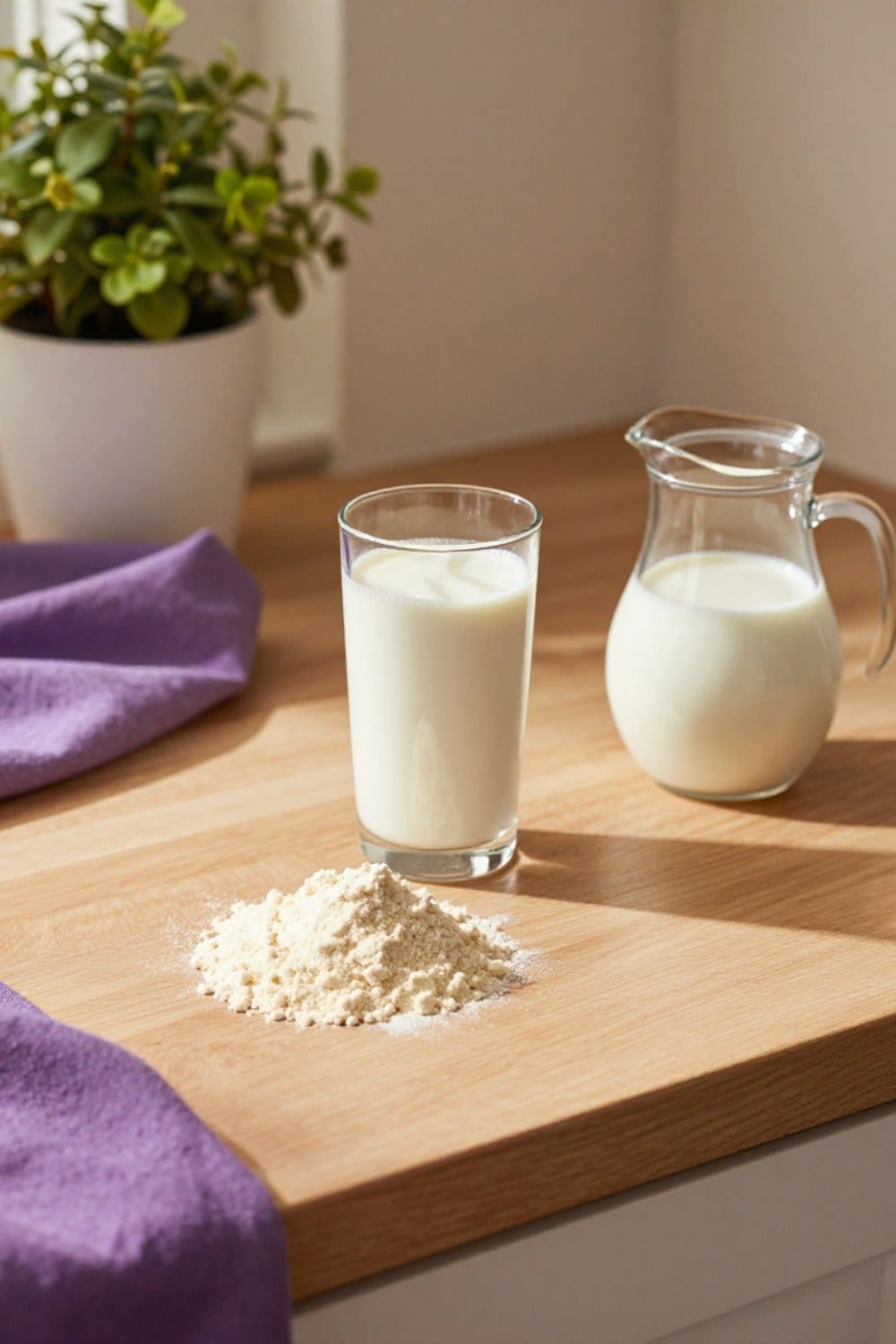
Strip away the marketing and a tub of protein powder is just this: protein pulled from a food — milk, peas, rice, eggs or soy — dried and ground into a powder. That's the whole idea. It's concentrated food, not medicine, and it isn't reviewed the way medicine is before it reaches a shelf.
The baseline number most nutrition guidance starts from is about 0.36 grams of protein per pound of body weight — a little over 7 grams for every 20 pounds you weigh. A lot of the research on women in midlife points meaningfully higher than that baseline, which is exactly why it deserves its own number rather than a guess here.
Whey Or Plant? The Honest, Plain-Words Version
Whey is the protein pulled from milk. It's what most of the classic tubs are made from, and it earned that reputation honestly — your body absorbs it quickly, and it's what's called a 'complete' protein, meaning it carries every essential building block your body needs to make new protein, in one scoop.
Plant protein usually comes from peas, rice, soy, or a blend of those. A single plant source sometimes runs a little light on one building block or another — pea protein comes up short on one, rice on a different one. Blend two together, the way most plant protein powders already do, and you get a scoop that covers close to the same ground whey does.
So if dairy doesn't sit well with you, or you're simply not a whey person, a good plant blend isn't a downgrade. Pick whichever one you'll actually finish the tub of — that decides whether this does anything for you far more than whey versus plant ever will.
What To Actually Check Before You Buy
Most tubs are designed to be read from the front, not the back. Here's what I'd actually look at, roughly in order of how much it matters.
- Protein per scoop. Check the real number in grams, not the size of the word 'PROTEIN' on the front. Decent scoops usually land around 20 to 30 grams — much lower, and you're paying for flavoring more than protein.
- A short ingredient list. A handful of ingredients you can mostly pronounce is a good sign. A long list of thickeners, dyes and sweeteners is worth a second look, even when the front label is impressive.
- Added sugar. Some flavored tubs carry more than you'd expect from a health-food-aisle product. Not a failing — just worth knowing before it surprises you.
- Third-party testing. The one most women skip, and the one that matters most in this particular aisle. More on why, just below.
Let's slow down on that last one — it's the part almost nobody explains clearly.
None of that means every uncertified tub is a problem. It means you're deciding whether to trust the label at face value, in a category where nobody's required to double-check it for you. A third-party seal is the simplest way to stop guessing.
What To Skip
A few things worth knowing before you spend money on the wrong version of this.
Collagen, Marketed As A Muscle-Builder
Collagen is having a moment, and a lot of it gets marketed right alongside protein powder as if it does the same job. It doesn't. In a trial of women in their 60s and 70s, an equal dose of whey set off a bigger muscle-building response than collagen did, so collagen isn't a stand-in for protein powder.
Collagen has a real lane — connective tissue and skin research is more promising, and that's a fair reason to take it. Just don't buy it expecting it to do what your whey or plant tub already does.
"Menopause" Protein Blends
I've looked, and I haven't found real evidence that a powder marketed specifically 'for menopause' does anything a plain protein powder doesn't. Usually it's the same protein, with a few extra ingredients and a higher price tag stapled to the word 'menopause.'
If the extras are things you'd buy anyway — added fiber, vitamin D, something you already take — fine, that's a reasonable convenience. If the entire appeal is the label matching your life stage, you're paying for marketing, not a different product.
Anything Sold With Fear
You'll recognize the style: a countdown, a scary statistic, a promise that this one tub stands between you and feeling like yourself again. That style of selling is a bigger red flag than anything in the ingredient list. A product that has to scare you into buying it usually isn't confident enough to just tell you plainly what it does.
How To Actually Use It
If you've decided a scoop makes sense for you, using it is simpler than the internet makes it look. You don't need a blender collection, a shaker cult, or a recipe to follow.
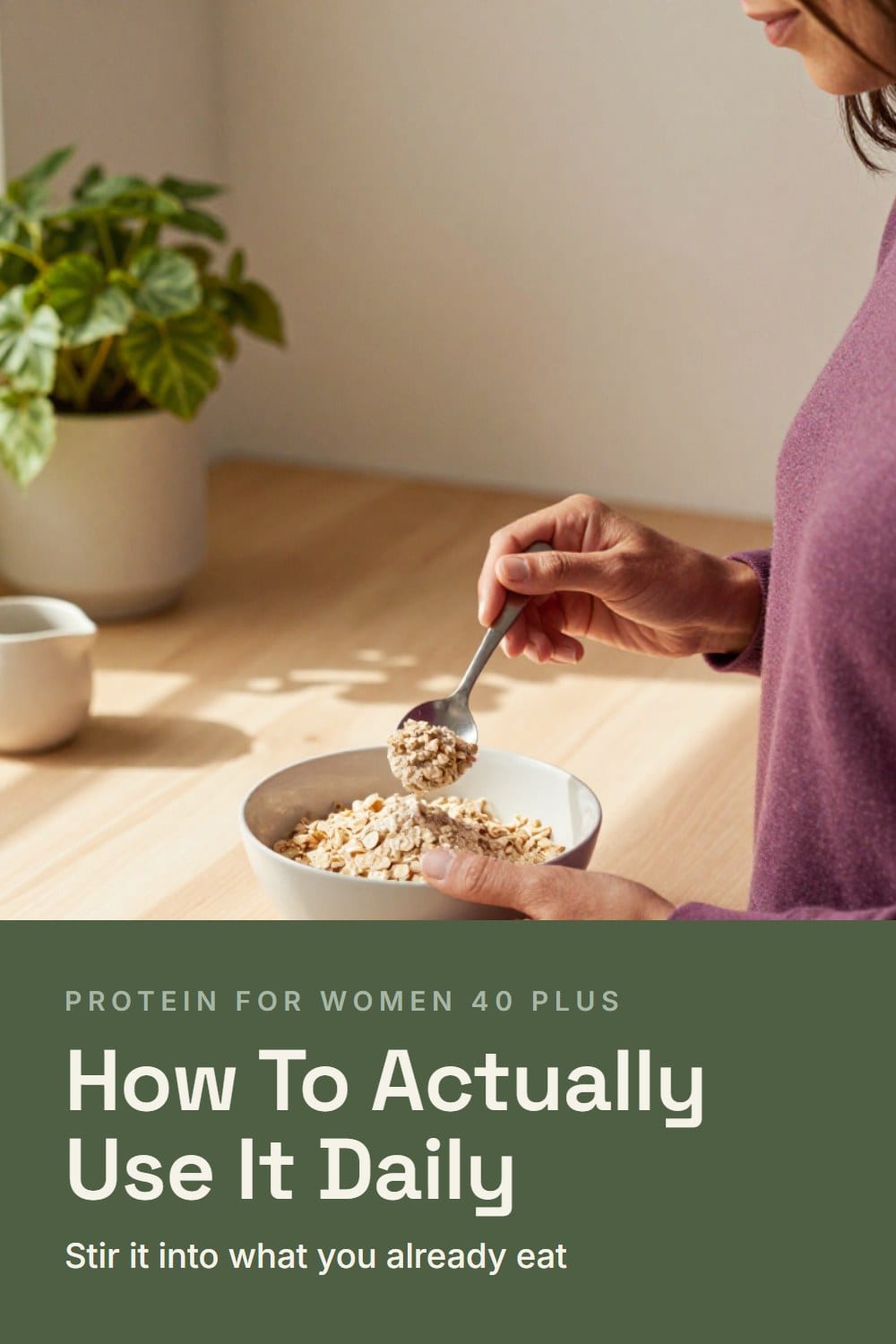
Stir it into a glass of milk, into plain yogurt, into oatmeal after it's cooked, or into a smoothie built around fruit you already have on hand. An unflavored version is the most flexible choice for this, since it won't fight with whatever you're adding it to.
Where you put your protein during the day matters, too — maybe more than you'd expect. A look at how older adults actually eat found a substantial share falling short of their daily protein target without ever trying to. The general advice is to spread it across breakfast, lunch and dinner rather than loading most of it into dinner, the way a lot of us do by habit. A scoop at breakfast — the meal you're most likely under-eating protein at — is one of the more useful places to put it.
When Protein Powder Actually Earns Its Place
This isn't a rule — just the honest pattern of when food already covers it, and when a scoop is a reasonable shortcut.
| Situation | A better food option first | When the scoop actually wins |
|---|---|---|
| A rushed weekday morning | A hard-boiled egg or a Greek yogurt cup | When there's truly no food around and the choice is a shake or nothing until lunch |
| Right after a strength session | Milk, string cheese, or the eggs already in your fridge | When you're headed out the door to hours with no real food around |
| Appetite running smaller than it used toWorth mentioning to your doctor if it's an ongoing pattern, not an occasional day. | Cottage cheese, or a smoothie with real fruit and milk | When even a few bites feel like too much, but a shake still goes down |
| Trying to add a lot more protein, fast | A second egg, more Greek yogurt, or more chicken or beans at dinner | When food alone means eating past comfortable, and a scoop closes the gap |
| An ordinary day with an ordinary appetite | Breakfast, lunch and dinner, the way you'd planned to eat them | Honestly? Rarely — this is the day the scoop is optional, not needed |
The Honest Picks, If You're Buying
If you've read all of this and you're still genuinely deciding to try one, here are honest starting points to compare. There's no single 'best' pick, since the right tub depends on your stomach, your taste, and whether you'll actually finish it.
A quick comparison across the basics — whey, plant, unflavored, single-serve, and the one accessory that actually helps.
| What it is | Best for | Why I'd pick it |
|---|---|---|
| Whey Protein Isolate, Unflavored or Vanilla Isolate strains out most of the lactose, which is worth knowing if dairy usually gives you trouble. | A fast-absorbing, complete protein with a long track record | Isolate strains out most of the lactose, which is worth knowing if dairy usually gives you trouble. |
| Plant-Based Protein Blend (Pea + Rice) Two plant proteins blended together cover for what either one is missing alone, so it holds up well against whey for the same job. | Dairy-free, vegan, or a stomach that does better without whey | Two plant proteins blended together cover for what either one is missing alone, so it holds up well against whey for the same job. |
| Unflavored Protein Powder No added sweetener or flavoring to work around — just protein you can add to oatmeal, yogurt or a glass of milk. | Stirring into what you already eat without changing the taste | No added sweetener or flavoring to work around — just protein you can add to oatmeal, yogurt or a glass of milk. |
| Single-Serve Protein Powder Packets One packet answers the only question that matters, will you actually like it, without a full tub taking up pantry space for a year. | Travel days, a desk drawer, or trying a brand before committing | One packet answers the only question that matters, will you actually like it, without a full tub taking up pantry space for a year. |
| Shaker Bottle with Wire Mixing Ball A small wire ball inside does the mixing work a spoon and a glass can't quite manage on their own. | Smooth mixing without clumps, no blender required | A small wire ball inside does the mixing work a spoon and a glass can't quite manage on their own. |
No prices here — Amazon requires them to be live, so click through to see what something costs today. Equipment helps; it is never the thing that makes a plan work.
None of this is a recommendation for your specific body or your specific health history — just the honest, general picture, sourced plainly below so you can check it yourself.
Where this comes from
Every claim traces to one of these five.
- 1Protein
Harvard T.H. Chan School of Public Health
Supports: That the baseline recommended protein intake is about 0.36 grams per pound of body weight — a little over 7 grams for every 20 pounds you weigh — and that a 'complete' protein contains all the essential amino acids the body needs to build new protein, while an individual plant protein source is sometimes missing one or more of them.
- 2The Scoop on Protein Powder
Harvard Health Publishing · 2020
Supports: That protein powder is classified as a dietary supplement and isn't regulated the same way food or medicine is, that rice and pea protein have been shown to support muscle growth similar to whey, and that NSF International's 'Certified for Sport' program checks that a product's contents match its label, confirms basic manufacturing standards, and rules out unsafe levels of toxic metals.
- 3Muscle Loss and Protein Needs in Older Adults
Harvard Health Publishing
Supports: That a substantial share of older adults surveyed did not meet daily protein recommendations, and that experts recommend spreading protein across the day with a good source at each meal rather than concentrating most of it in one meal.
- 4Whey Protein but Not Collagen Peptides Stimulate Acute and Longer-Term Muscle Protein Synthesis With and Without Resistance Exercise in Healthy Older Women: A Randomized Controlled Trial
The American Journal of Clinical Nutrition · 2020
Supports: That in a trial of women ages 60 to 80, a 30-gram dose of whey protein produced a significantly greater rise in the body's muscle-building response than an equal, calorie-matched dose of collagen peptides, both at rest and paired with exercise.
- 5Dietary Protein Distribution Positively Influences 24-h Muscle Protein Synthesis in Healthy Adults
The Journal of Nutrition · 2014
Supports: That spreading about 30 grams of protein evenly across breakfast, lunch and dinner produced a 24-hour muscle-building response roughly 25% higher than eating the same total amount of protein concentrated mostly at dinner.
Free, and printable
The free 4-Week Indoor Walking Plan
The plan sign-up is not live yet — the mailing list is still being set up. In the meantime, email hello@strongandrooted.com and Diane will send it to you herself.
One email when there is something worth sending. Unsubscribe whenever you like.
Frequently asked questions
Do I actually need protein powder if I'm over 40?
Is collagen protein good for muscle?
Whey or plant protein — which is actually better?
What's the one thing to check before buying a protein powder?
Here's the short version, one more time: most of this is food's job, not a supplement's. Get clear on how much protein you're actually aiming for, build it into meals first, and use a scoop as the backup plan for the days food doesn't cover it — not the plan itself. If you're doing any strength training, protein is the raw material for the muscle you're building. For the fuller picture, our complete nutrition and protein guide is the place to start — this is one piece of it, not the whole thing.
Free, and printable
The 4-Week Indoor Walking Plan
The plan sign-up is not live yet — the mailing list is still being set up. In the meantime, email hello@strongandrooted.com and Diane will send it to you herself.
One email when there is something worth sending. Unsubscribe whenever you like.
Written by
Diane Marsh
At 49 I was tired, achy, sleeping badly, and being told to do more cardio and eat less — which was making all of it worse. I started walking. Fifteen minutes, indoors, in socks. Three years later I am stronger than I was at forty. I write down exactly what I did, cite the research where it exists, and admit where it doesn't.
Diane is not a doctor, a physical therapist, or a dietitian. She is a woman who rebuilt her own strength after perimenopause, reads the research carefully, cites it, and says so when nobody actually knows.
Strong & Rooted is a participant in the Amazon Services LLC Associates Program, an affiliate advertising program designed to provide a means for sites to earn advertising fees by advertising and linking to Amazon.com. As an Amazon Associate I earn from qualifying purchases. If you click a link and buy something, I may receive a small commission at no additional cost to you. I recommend only equipment I have used myself or would hand to a friend, and commission never decides the order of a list. Prices are never shown here because Amazon requires displayed prices to be live — click through to see what something costs today.
Keep reading
This is the whole nutrition territory in one honest place — not a diet, not a meal plan, just four ideas that actually hold up: protein, fiber, steady energy and what's really just marketing. Read it once and you'll know exactly which deeper guide is yours.
Blood-Sugar-Friendly Habits for Steadier Energy After 40The 3 PM crash feels like a personal failing, but it's mostly a blood-sugar story — what you ate, in what order, and whether you moved afterward. Here's what's actually happening after a meal, why it can feel different in midlife, and the small, honest swaps that make the afternoon gentler.
How Much Protein Do You Actually Need After 40?Most of us are eating less protein than we think, and the old government minimum was never built for a woman trying to hold onto her muscle after 40. Here's the real number in grams you can actually use, why it goes up instead of down with age, and what a full day of it looks like on an ordinary plate — no recipes required.