Getting Enough Protein at Breakfast (The Meal That Sets Up Your Day)
Breakfast is very likely the single meal where you're losing the most ground on protein — and it's also the easiest one to fix, because unlike dinner, breakfast repeats every day. Here's what a real protein-forward breakfast actually looks like, the five-minute and night-before options, and an honest answer for mornings when you're just not hungry.

By Diane Marsh··9 min read
Claims on this page are checked against a study in the Journal of Nutrition where researchers controlled what people ate, a nutrition-and-aging review in the journal Nutrients, and two Harvard Health articles — all four sources are linked below.
General education, not medical advice. Talk to your doctor before starting something new.
The short version
- Most women eat the least protein at the one meal that could use it most — breakfast — and the most at dinner, hours after it could have done much good that day.
- Spreading protein across the day, instead of saving most of it for dinner, appears to help your body actually use it, not just take it in.
- Aiming for around 25 to 30 grams of protein at breakfast is a reasonable, well-supported target — and it doesn't require cooking or a recipe.
- If you're genuinely not hungry first thing, that's real biology, not a discipline problem — the honest fix is later and smaller, not bigger and earlier.
- None of this is a race. The best option is the one you'll actually make again tomorrow, not the most impressive one you tried once.
If your breakfast most days is coffee and something made of bread, you're not doing anything wrong on purpose, and you're definitely not alone. Toast and coffee is a genuinely lovely little ritual.
It's just not built to help a 45-year-old body hold onto the muscle it's already starting to lose. Here's the honest version of that problem, up front: breakfast is very likely the single meal where you're losing the most ground on protein — and it's also the easiest one to fix, because unlike dinner, breakfast repeats. You eat some version of it almost every day. Fix it once, and it keeps working for you all by itself.
This isn't about a smoothie bowl with eleven ingredients, and it isn't about giving up toast forever if you genuinely love it. It's one honest, repeatable swap — described here as food, never as a recipe — that you could actually start tomorrow morning.
Why Breakfast Is Where the Protein Habit Actually Breaks
When researchers have actually looked at how women eat across a full day, the same pattern keeps showing up: protein starts small at breakfast, grows at lunch, and peaks at dinner.
That's not a character flaw. It's just how a lot of us were taught to eat — cereal, toast, fruit, coffee. All perfectly ordinary foods. None of them carrying much protein at all. Dinner is where the chicken, the fish and the beans finally show up, hours after your body could have put that protein to use.
So the fix isn't necessarily eating more protein overall — how-much-protein-after-40 walks through your full daily target, if you want that math. This is narrower, and honestly easier: move some of the protein you're probably already eating later in the day up to the start of it.
What a Real Protein Breakfast Actually Looks Like
A reasonable target to aim for is somewhere around 25 to 30 grams of protein at breakfast. That number isn't arbitrary, and it isn't a diet-culture number either — it's roughly what shows up across the research as a useful amount for one sitting, and it happens to be realistic on an actual plate, not just in a study.
Here's what 25 to 30 grams actually looks like on a plate — described as food, never as a recipe:
- Two eggs (about 12 grams) with milk in your coffee and a piece of fruit
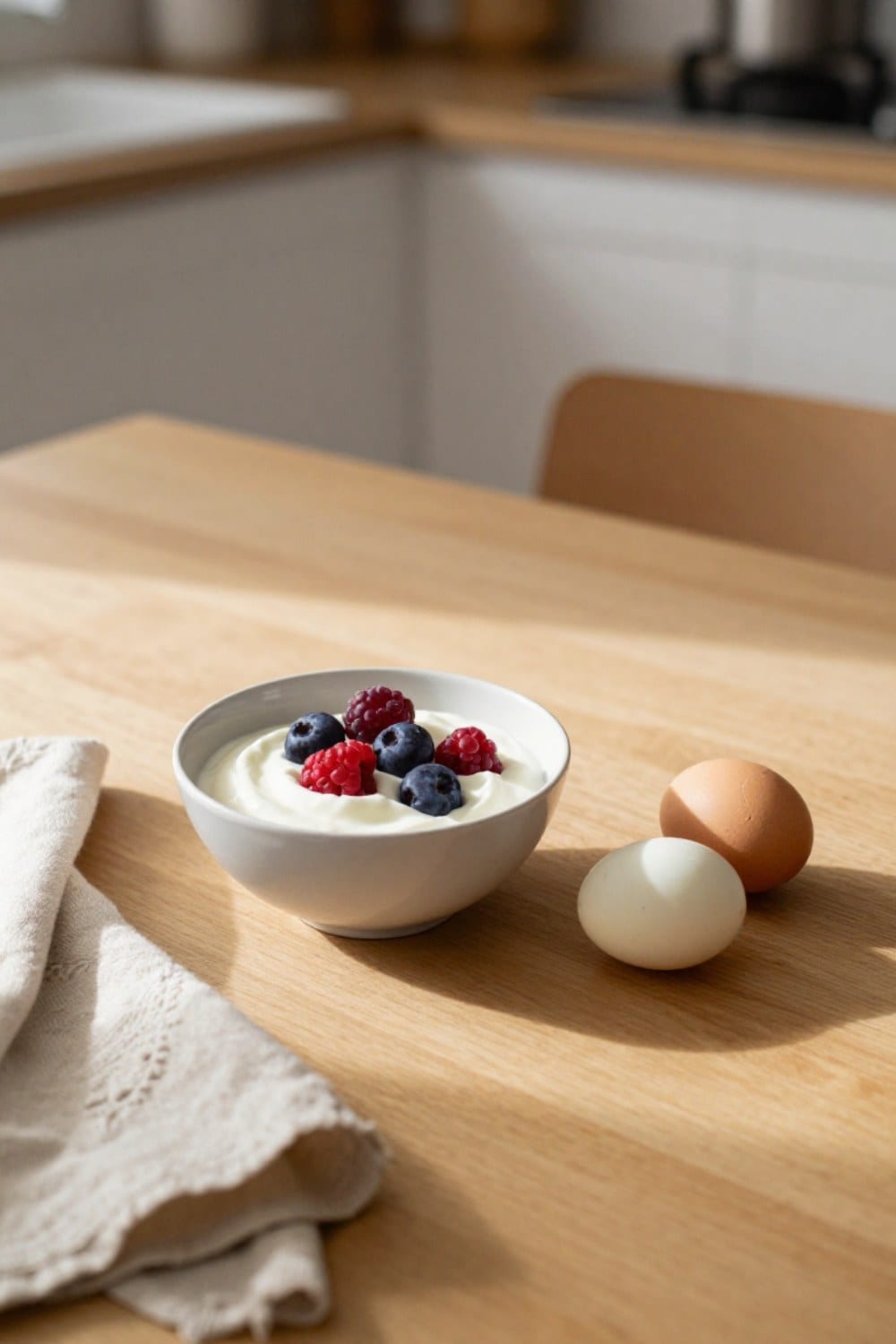
- A bowl of plain Greek yogurt (about 17 grams in three-quarters of a cup) with berries and a spoonful of peanut butter (7 more grams)
- A cheese stick or two (5 to 7 grams each) with a small handful of almonds and some fruit
- A pouch of tuna or salmon (about 25 grams) with whole-grain crackers
- Leftover chicken, turkey or salmon from last night's dinner, eaten cold, with fruit on the side
None of it requires a stove if you don't feel like using one that morning. What it actually requires is having a few specific things in the house — which is a shopping habit more than a cooking one. easy-high-protein-habits has the fuller grocery list; this is just the breakfast slice of it.
The Five-Minute (and Night-Before) Options
Some mornings you have five spare minutes. Some mornings you had five minutes the night before and have none today. Both are completely workable — you just need to know which move fits which kind of morning.
Breakfast options worth keeping on hand
Rough protein counts, so you know what you're actually getting — not a schedule to follow in order.
| Option | Rough protein | How long it takes | Who it suits |
|---|---|---|---|
| Greek yogurt, berries and peanut butter | About 24 grams | 2 minutes | Mornings you want cold, not cooked |
| Two eggs, any style, with fruit | About 12 grams | 5 to 8 minutes | Mornings you have a few minutes and a stove |
| A pouch of tuna or salmon with crackers | About 25 grams | 3 minutes | Savory-morning people, or hot weather when cold food appeals more |
| A protein shake made with milkIf a shake is the realistic option most mornings, protein-powder-for-women-over-40 covers how to pick one you'd actually trust. | 20 to 30 grams, depending on the scoop | 3 minutes | Rushing out the door |
| Overnight oats with Greek yogurt stirred in | About 20 grams | 5 minutes the night before, 0 in the morning | Anyone who's never hungry right when they wake up |
| A batch of hardboiled eggs from the fridge | About 12 grams for two | 0 minutes — already done | Grab-and-go mornings |
| Cottage cheese with fruit or honey | About 12 grams in three-quarters of a cup | 2 minutes | The mornings you don't want to chew much |
| A cheese stick and a handful of almonds | About 12 grams | 1 minute | A bridge, not a full breakfast, for the truly not-hungry-yet mornings |
| Leftover chicken, turkey or salmon, cold | 20 to 25 grams, depending on the portion | 2 minutes | Whoever doesn't love traditional "breakfast food" |
A jar of chia pudding made with milk or yogurt and left in the refrigerator overnight is another version of the same idea. The theme across all of these is the same: decide once, usually the night before or on a slow Sunday, and let tomorrow-you just reach for it.
If You're Just Not Hungry That Early
For a real number of women, none of the above lands, because the actual problem isn't what to eat at 7am — it's that nothing sounds good at 7am. If that's you, I believe you, and this part is written specifically for you.
It's not a discipline problem, and it isn't just you. Appetite genuinely shifts as we get older, and the same research mentioned earlier on protein distribution has found that appetite tends to run lower overall in older adults than in younger ones. If mornings are the quietest part of your appetite, that lines up with real biology, not a personal failing.
If you want a bridge for the gap between waking up and actual hunger, small works better than big: a hardboiled egg you can eat in three bites, a small handful of nuts, a piece of string cheese. None of it needs to be a full breakfast. It just needs to keep the door open until real hunger arrives.
The Coffee-Only Truth
Some mornings — some women, some entire seasons of life — the honest answer is that she is not going to eat, period, no matter what's on the plate. If that's genuinely you most days, I'm not going to spend three paragraphs pretending a bowl of overnight oats is about to change your mind.
Here's what actually helps instead: let the coffee stay the coffee, and quietly upgrade what rides along with it. A splash of milk instead of only creamer. A small protein shake sipped like a second coffee, not eaten like a meal. Or simply moving your protein-forward meal to whenever your appetite genuinely opens up — a plate at your desk at 10 counts exactly as much as one at your kitchen table at 7.
protein-powder-for-women-over-40 is worth a look if a shake is more realistic for you most mornings than a plate — it's a completely reasonable way to get there, not a lesser one.
Protein at Breakfast Is Only Half the Story
None of this matters much in isolation. Protein without something asking your muscles to actually use it is just protein sitting there — strength-training-for-beginners-over-40 is where the other half of this lives, and it's worth starting if you haven't yet.
And if steady energy through the rest of the morning is what you're actually chasing, more than the number on a nutrition label, blood-sugar-friendly-habits-for-energy picks up almost exactly where this leaves off.
None of this is a diagnosis or a promise about your specific body — only what the general research supports, cited plainly below so you can go read it yourself instead of just trusting me.
Where this comes from
Every claim above traces to one of these four.
- 1Musculoskeletal syndrome of menopause: When menopause makes you ache all over
Harvard Health Publishing · 2026
Supports: That declining estrogen during perimenopause and menopause is linked to reduced muscle mass and bone density, along with widespread joint and muscle aches, affecting an estimated 70% of women during this transition — and that strength training helps by maintaining and building the muscle that supports the joints.
- 2Protein for Life: Review of Optimal Protein Intake, Sustainable Dietary Sources and the Effect on Appetite in Ageing Adults
Nutrients · 2018
Supports: That U.S. data on women aged 51 to 71 shows an average of just under 12 grams of protein eaten at breakfast compared with about 30 grams at dinner; that protein distribution across meals matters at least as much as the total daily amount; that around 25 to 30 grams of protein per meal, two to three times a day, is a reasonable target; and that appetite genuinely tends to run lower overall in older adults than in younger ones.
- 3Dietary Protein Distribution Positively Influences 24-h Muscle Protein Synthesis in Healthy Adults
The Journal of Nutrition · 2014
Supports: That in a study where researchers controlled what people ate, spreading the same total protein evenly across three meals produced about 25% more muscle-building activity over 24 hours than eating most of that protein at dinner; that a 30-gram breakfast produced about 30% more of that activity than a 10-gram breakfast, an effect that held up after a full week of eating that way; and that U.S. adults typically eat roughly three times more protein at dinner than at breakfast.
- 4High-protein snacks to build muscle and keep hunger at bay
Harvard Health Publishing · 2024
Supports: That the body can generally use somewhere around 20 to 40 grams of protein at a single meal; that adequate protein alongside regular exercise helps offset the natural age-related tendency to lose muscle; and specific protein counts for common foods, including about 6 grams per hardboiled egg, about 17 grams per three-quarters cup of Greek yogurt, and about 12 grams per three-quarters cup of cottage cheese.
Free, and printable
The free 4-Week Indoor Walking Plan
The plan sign-up is not live yet — the mailing list is still being set up. In the meantime, email hello@strongandrooted.com and Diane will send it to you herself.
One email when there is something worth sending. Unsubscribe whenever you like.
Frequently asked questions
How much protein should I actually eat at breakfast?
What if I'm genuinely not hungry in the morning?
Is a protein shake as good as eating real food at breakfast?
Can't I just get my protein total in later in the day instead?
A better breakfast isn't a personality overhaul — it's one small, repeatable swap. Start with whichever option above sounds like something you'd actually make again tomorrow, not the most impressive one on the list. For the full math on your daily target, how-much-protein-after-40 has it, and nutrition-and-protein-after-40-complete-guide is the place to start if you want the whole nutrition picture, not just the one meal.
Free, and printable
The 4-Week Indoor Walking Plan
The plan sign-up is not live yet — the mailing list is still being set up. In the meantime, email hello@strongandrooted.com and Diane will send it to you herself.
One email when there is something worth sending. Unsubscribe whenever you like.
Written by
Diane Marsh
At 49 I was tired, achy, sleeping badly, and being told to do more cardio and eat less — which was making all of it worse. I started walking. Fifteen minutes, indoors, in socks. Three years later I am stronger than I was at forty. I write down exactly what I did, cite the research where it exists, and admit where it doesn't.
Diane is not a doctor, a physical therapist, or a dietitian. She is a woman who rebuilt her own strength after perimenopause, reads the research carefully, cites it, and says so when nobody actually knows.
Keep reading
This is the whole nutrition territory in one honest place — not a diet, not a meal plan, just four ideas that actually hold up: protein, fiber, steady energy and what's really just marketing. Read it once and you'll know exactly which deeper guide is yours.
Blood-Sugar-Friendly Habits for Steadier Energy After 40The 3 PM crash feels like a personal failing, but it's mostly a blood-sugar story — what you ate, in what order, and whether you moved afterward. Here's what's actually happening after a meal, why it can feel different in midlife, and the small, honest swaps that make the afternoon gentler.
How Much Protein Do You Actually Need After 40?Most of us are eating less protein than we think, and the old government minimum was never built for a woman trying to hold onto her muscle after 40. Here's the real number in grams you can actually use, why it goes up instead of down with age, and what a full day of it looks like on an ordinary plate — no recipes required.