Blood-Sugar-Friendly Habits for Steadier Energy After 40
The 3 PM crash feels like a personal failing, but it's mostly a blood-sugar story — what you ate, in what order, and whether you moved afterward. Here's what's actually happening after a meal, why it can feel different in midlife, and the small, honest swaps that make the afternoon gentler.

By Diane Marsh··10 min read
Claims on this page are checked against NIDDK, The Menopause Society, Cleveland Clinic, Harvard Health, and two peer-reviewed studies on meal order and blood sugar — all seven sources are linked below.
General education, not medical advice. Talk to your doctor before starting something new.
The short version
- The 3 PM crash is ordinary biology — a blood-sugar rise and fall — not a character flaw.
- Estrogen genuinely affects how your cells respond to insulin, and that can shift through midlife — but nobody can tell you exactly how much of any one crash is hormones versus habits.
- The order you eat a meal in — protein and vegetables before the starchy part — tends to soften the blood-sugar rise that follows.
- Skipping breakfast to 'save room' tends to set up a harder landing at lunch, not a clean slate.
- A CGM isn't something a healthy woman needs to buy — it's a tool built for diabetes management, worth a doctor's conversation if you're genuinely curious.
Three o'clock hits, and the whole day suddenly feels impossible. Your eyes want to close, the coffee's stopped working, and some part of you wonders if this is just what being over 40 feels like now.
Here's what I want you to know before we go any further: you're not lazy, and nothing about you is broken. A lot of that crash traces back to breakfast and lunch — what was on the plate, what order it went in, and whether you moved afterward. Some of it really does trace back to midlife, and we'll talk about that honestly too. Both things can be true, and neither one means you're stuck with it.
A note
What's Actually Happening At 3 PM
Here's the plain version, no lab coat required. When you eat something with carbohydrates in it — bread, cereal, fruit, pasta, a cookie — your body breaks it down into a sugar called glucose, and that glucose moves into your bloodstream.
Your blood sugar is supposed to rise a bit after you eat. That part is normal, and it happens to everyone, every single day. Your body then releases insulin, a hormone whose job is to help usher that glucose out of your blood and into your cells, where it gets used for energy or tucked away for later.
The crash shows up when that rise is steep and fast — a real spike — followed by a matching drop. You feel the spike as a jolt of okay-I-can-do-this, and you feel the drop as the wall: heavy eyelids, a fuzzy head, and a sudden, urgent need to lie down under your desk.
None of this is unique to you, and none of it means something is wrong. It's ordinary biology, doing exactly what it's built to do. The part you actually have some say over is the size of the swing — how steep the climb and how hard the fall — and that's decided mostly by what happened at the table, not by anything happening at 3 PM itself.
Why It Can Feel Different Now
If you've noticed that the same lunch hits you harder at 48 than it did at 28, you're not imagining it, and I'm not going to pretend the honest answer is simple.
Estrogen has a hand in how well your cells respond to insulin. As it declines through perimenopause and into menopause, that response can get a little less efficient for a lot of women — a real, physiological thread, not a rumor floating around midlife wellness accounts.
Here's the honest limit of that, though: it doesn't tell us exactly how much of your particular 3 PM crash is hormones, versus sleep, versus stress, versus what was actually on your plate, versus just a long day. Nobody's found a clean way to separate those out yet, and I'd be careful of anyone who tells you they have.
What we do know is that the habits below help with the blood-sugar side of that equation regardless of how much of your crash turns out to be hormonal — so you don't actually have to solve that puzzle to feel steadier by 3 PM.
The Habits Actually Worth Stealing
None of these require a special diet, a supplement, or giving up anything you genuinely love. They're small, ordinary swaps — the kind you can start at your very next meal, without telling anyone you're doing it. They also work best alongside the muscle you're building, since a stronger body is a good companion to any of these swaps.
A day of small swaps for steadier energy
Pick the moment that fits your actual day. You don't need all four at once to notice a difference.
| Moment | What Usually Happens | The Small Swap | Why It Helps |
|---|---|---|---|
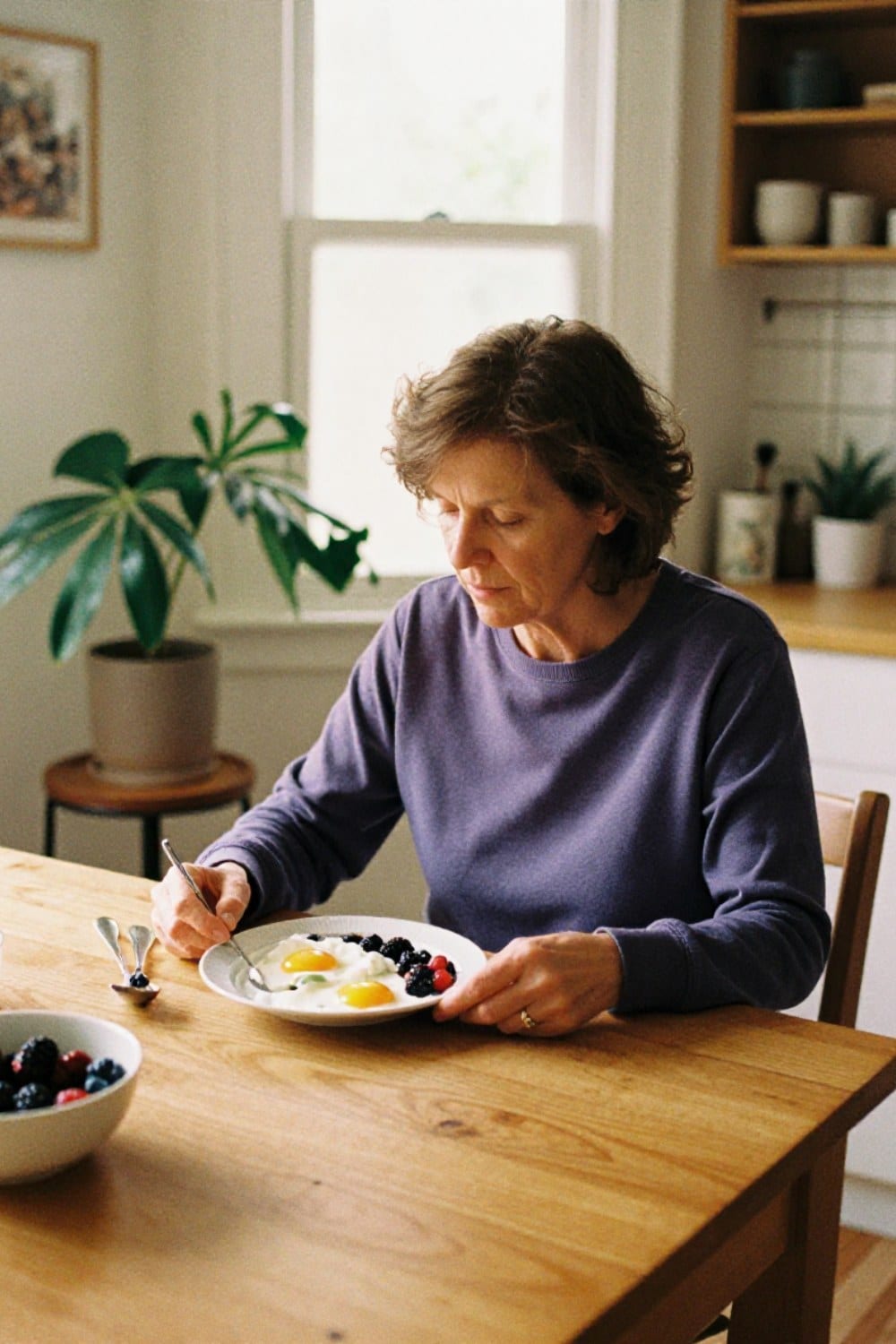
| BreakfastThis doesn't mean a big cooked breakfast. A hard-boiled egg counts. | Coffee and not much else, or a pastry eaten standing at the counter | Add something with protein — eggs, Greek yogurt, cottage cheese — even right alongside the pastry | Starting the day on fast carbohydrates alone tends to set up a bigger swing by mid-morning; protein at breakfast is linked to steadier energy at the very meal you're dreading |
| LunchSame meal, same plate, just a different order. Nothing to buy, nothing to give up. | The fastest, easiest carbohydrate goes first — the bread, the chips, the rice | Eat the protein and vegetables first, and save the bread or rice for last | In real research, this exact swap — protein and vegetables before the starchy part — softened the rise that follows, without changing a single ingredient on the plate |
| Right After LunchIf you can only add one thing from this whole table, most women find this the easiest to keep. | Straight back to the desk, or straight to the couch | A 10-minute walk — around the block, the parking lot, or the hallway | This is its own whole habit with its own real evidence — <a href="/metabolic-walking-after-40/">metabolic walking after 40</a> covers exactly why a short walk timed to a meal works so well |
| 3 PMThe honest answer isn't 'never have the cookie.' It's 'don't have it alone.' | A cookie or a handful of candy from the break room, eaten alone, on an empty stomach | Something with protein alongside it, or instead of it — a cheese stick, a handful of almonds, a hard-boiled egg | Pairing something sweet with protein softens the swing; skipping the snack outright and running on empty tends to make the next spike worse, not better |
The 'order you eat things' swap sounds almost too simple to matter, so here's the honest evidence behind it. In one study, healthy young women who ate their vegetables before the rest of a meal saw a noticeably smaller rise in blood sugar afterward than when they ate the same meal carbohydrates-first — and it didn't matter whether they ate quickly or slowly. Fiber has its own deeper story in midlife, worth reading on its own — but this order-of-eating trick works even before you change a single thing about what's actually on the plate.
Skipping breakfast to 'save room' for lunch tends to backfire in a specific way. When researchers looked at breakfast habits across a large number of people, regularly skipping breakfast showed up alongside roughly a 10% higher rate of metabolism-related issues, including blood sugar — it doesn't prove skipping breakfast causes it, but it's a pattern worth taking seriously instead of talking yourself out of. If mornings are rushed, this doesn't have to be a production — a few honest ways to get protein at breakfast without cooking a full meal are worth a look.
What Steadier Energy Actually Feels Like
Steadier doesn't mean a flat line, and it doesn't mean wired-at-9-PM energy that keeps you up half the night. It means the dip gets smaller and later, instead of arriving hard at 2:45 and wrecking the rest of your afternoon.
It means sitting through a 4 PM meeting without silently bargaining with yourself about leaving early. It means dinner doesn't turn into a free-for-all because lunch wore off three hours ago and you're suddenly starving.
I want to be honest about what this is not: it's not a plan for losing weight, and I'm not going to measure your progress by a number on a scale. This is about how your Tuesday afternoon actually goes — your focus, your patience, the energy to walk the dog after work — not about changing your body. Strong, not skinny.
Where this comes from
Every claim above traces to one of these seven.
- 1Insulin Resistance & Prediabetes
National Institute of Diabetes and Digestive and Kidney Diseases (NIH)
Supports: That after eating, carbohydrates break down into glucose that enters the bloodstream, that insulin's job is to help cells take that glucose up, and that when cells respond to insulin less readily, blood glucose can run higher than it otherwise would — a well-documented, common shift that daily movement and eating habits can help ease.
- 2New Meta-Analysis Shows That Hormone Therapy Can Significantly Reduce Insulin Resistance
The Menopause Society
Supports: That pooling results across carefully controlled hormone-therapy studies, researchers found hormone therapy measurably eased insulin resistance in healthy postmenopausal women without an existing metabolic condition — real evidence of a link between declining estrogen and how readily the body responds to insulin, though it doesn't say how much of any one woman's afternoon energy traces to that link versus everything else in her day.
- 3Eating Vegetables First Regardless of Eating Speed Has a Significant Reducing Effect on Postprandial Blood Glucose and Insulin in Young Healthy Women: Randomized Controlled Cross-Over Study
Nutrients · 2023
Supports: That in healthy young women with no history of diabetes, eating vegetables before the rest of a meal — regardless of how quickly they ate — led to a noticeably smaller rise in blood sugar and insulin afterward than eating the same meal carbohydrates-first.
- 4Effects of Meal Sequence Intervention on Blood Glucose Response in Healthy Adults: A Systematic Review
Clinical Nutrition Research · 2026
Supports: That pulling together six small studies on healthy adults, eating vegetables, fruit or protein before the carbohydrate part of a meal consistently softened the blood-sugar rise that followed — a consistent pattern, though the authors note the research is still small and would benefit from bigger, longer studies.
- 5Continuous Glucose Monitoring (CGM): What It Is
Cleveland Clinic
Supports: That a continuous glucose monitor is mainly a tool built for people managing diabetes, that a healthcare provider might recommend one for specific conditions like prediabetes, and that anyone considering one should talk with their provider about whether it would actually be useful for them.
- 6Skipping breakfast may increase risk for metabolic syndrome
Harvard Health Publishing
Supports: That pooling data across multiple large studies, regularly skipping breakfast was linked with roughly a 10% higher rate of metabolic syndrome — a cluster that includes high blood sugar — though the research design can't prove skipping breakfast is the cause, only that the two show up together.
- 7How Walking After Eating Can Help Manage Your Blood Sugar
Cleveland Clinic
Supports: That a short walk soon after a meal blunts the blood-sugar rise that follows and keeps insulin steadier than staying seated — the full habit, timing and evidence are covered in this site's dedicated article on the after-meal walk.
Free, and printable
The free 4-Week Indoor Walking Plan
The plan sign-up is not live yet — the mailing list is still being set up. In the meantime, email hello@strongandrooted.com and Diane will send it to you herself.
One email when there is something worth sending. Unsubscribe whenever you like.
Frequently asked questions
Why do I crash so hard at 3 PM specifically?
Do I need a continuous glucose monitor (CGM) to figure this out?
Is this article about prediabetes or diabetes?
What should I actually do about the 3 PM cookie?
The 3 PM crash isn't a verdict on your willpower, and it isn't something you have to just live with either. Start with one swap — protein at breakfast, vegetables before the rice, or the ten-minute walk after lunch — and give it a couple of weeks before judging whether it's working. For the fuller picture on protein and gut-friendly habits after 40, the complete nutrition guide is the place to start next.
Free, and printable
The 4-Week Indoor Walking Plan
The plan sign-up is not live yet — the mailing list is still being set up. In the meantime, email hello@strongandrooted.com and Diane will send it to you herself.
One email when there is something worth sending. Unsubscribe whenever you like.
Written by
Diane Marsh
At 49 I was tired, achy, sleeping badly, and being told to do more cardio and eat less — which was making all of it worse. I started walking. Fifteen minutes, indoors, in socks. Three years later I am stronger than I was at forty. I write down exactly what I did, cite the research where it exists, and admit where it doesn't.
Diane is not a doctor, a physical therapist, or a dietitian. She is a woman who rebuilt her own strength after perimenopause, reads the research carefully, cites it, and says so when nobody actually knows.
Keep reading
This is the whole nutrition territory in one honest place — not a diet, not a meal plan, just four ideas that actually hold up: protein, fiber, steady energy and what's really just marketing. Read it once and you'll know exactly which deeper guide is yours.
How Much Protein Do You Actually Need After 40?Most of us are eating less protein than we think, and the old government minimum was never built for a woman trying to hold onto her muscle after 40. Here's the real number in grams you can actually use, why it goes up instead of down with age, and what a full day of it looks like on an ordinary plate — no recipes required.
Getting Enough Protein at Breakfast (The Meal That Sets Up Your Day)Breakfast is very likely the single meal where you're losing the most ground on protein — and it's also the easiest one to fix, because unlike dinner, breakfast repeats every day. Here's what a real protein-forward breakfast actually looks like, the five-minute and night-before options, and an honest answer for mornings when you're just not hungry.