Gentle Yoga for Women Over 40 (What It Actually Does)
Every wellness feed talks about gentle yoga like a nice-to-have. Here's the strongest evidence in this whole category — a Harvard-affiliated review linking yoga to real gains in walking speed and the ability to rise from a chair in people over 65 — plus the honest limits, and a real sequence to start with.
By Diane Marsh··11 min read
Claims on this page are checked against Harvard Health, Cleveland Clinic, the British Journal of Sports Medicine, and Pain Practice — all five sources are linked below.
General education, not medical advice. Talk to your doctor before starting something new.
The short version
- The best evidence in this whole category is about capability, not calm: a Harvard-affiliated review of 33 studies found yoga improved walking speed and the ability to rise from a chair in adults over 65.
- Gentle yoga is genuinely good for stiffness, mobility, breathing and sleep — it is not a bone-building plan and not a substitute for strength training.
- Declining estrogen is linked to more joint stiffness in midlife; gentle movement is associated with feeling less stiff, not a fix for the hormonal cause of it.
- If you have osteoporosis, osteopenia or a fracture history, several common poses need your doctor's or a physical therapist's sign-off first — forward folds carry real, documented risk.
- Chair yoga is a real, evidence-backed option — not a lesser version of the real thing.
If gentle yoga has always felt like the soft, optional thing you'd get to once the real workout was done, I want to open with a fact that changed my mind about that completely.
Harvard-affiliated researchers at Brigham and Women's Hospital reviewed 33 studies covering 2,384 people over 65, and found that the ones practicing yoga got measurably better at two specific things: walking speed, and the ability to stand up from a chair without using their hands. Doctors use both as real markers of frailty. That's not a mood. That's capability.
So this isn't only a serenity article, even though a calmer nervous system is a genuine part of what's coming. This is the honest map: what gentle yoga actually helps with, what it flatly is not, and how to do a real, gentle sequence without getting hurt — because a few of its most common poses can, if you have a bone condition you don't know about yet.
The Study That Made Me Take Yoga Seriously
Here's the finding in full, because it deserves more than a headline.
Those two measures aren't tracked because they're quaint — they're markers researchers use when they look at frailty in older adults.
Many of the studies in that review used chair-based yoga specifically, not advanced poses. Whatever produced the improvement, it wasn't difficulty. It was consistency.
What Gentle Yoga Is Actually Good For
Strip away the marketing, and here's the honest list:
- Stiffness and ease of movement. Slow, repeated movement through a joint's comfortable range is one of the simplest ways to make that joint feel less stuck.
- Mobility you actually use. Reaching a high shelf, turning to check a blind spot, getting up off the floor — gentle yoga rehearses exactly those movements.
- Breathing and your nervous system. The slow, paced breathing built into most gentle classes is genuinely calming, not just marketed that way.
- Sleep. A calmer nervous system before bed is one honest reason a lot of women notice better sleep on the days they practice.
- The frailty markers above. Walking speed and the ability to rise from a chair, per the Harvard-affiliated review — real capability, not flexibility for its own sake.
If stiffness on its own is your main complaint, rather than wanting a full practice, stretching for stiffness and achy joints over 40 goes deeper on that specific piece.
What Gentle Yoga Is Not — Let's Just Say It
Here's the part the yoga world rarely admits: gentle yoga is not heavy loading, so it doesn't ask your bones and muscles to work against meaningful resistance the way a loaded squat or a weighted row does. Two things follow. It's not your bone-density plan — exercises for bone density after 40 covers that job. And it's not a substitute for strength training — strength training for beginners over 40 is where the muscle- and bone-protective lifting happens; yoga is the joint-friendly complement, not a replacement.
Almost nothing else selling yoga will say this. It's easier to imply one practice does everything than to admit its honest job description: stiffness, mobility, ease of movement and calm — genuinely valuable, and genuinely not the whole plan.
Menopause, Joints, and What's Actually Going On
If your joints have gotten stiffer or achier sometime in the last few years and you can't point to an injury, you're not imagining it, and you're not out of shape. There's a real, hormonal reason, and it deserves a straight answer instead of a vague one.
That's useful, and it's also where I want to be careful, because it's easy to overstate. Gentle movement, including gentle yoga, is associated with feeling less stiff. It doesn't change the hormonal shift causing that stiffness — nothing in a yoga class changes your estrogen levels. What it can genuinely do is help the joints you already have move a little easier, day to day.
If a diagnosed joint condition, arthritis or a specific injury is what's actually going on, that's a conversation for your doctor or a physical therapist, not a yoga class or a blog post.
Gentle, Hatha, Restorative, Chair: What's The Difference
The style names get thrown around like they're interchangeable, and they're genuinely not. Here's the plain-English version:
- Gentle or hatha yoga is the slower-paced foundation — poses held for a breath or several, a reasonable place for almost anyone to start.
- Restorative yoga is slower still: mostly supported, reclined poses using pillows or a folded blanket, closer to guided rest than a workout.
- Chair yoga takes the same poses and adapts them to a sturdy chair, seated or standing-with-support — a real, complete option, not a lesser one.
- Hot or power yoga is a different category altogether: faster-paced, more athletic, sometimes in a heated room. It's not what 'gentle' means in this article, and it's not where I'd point a true beginner.
If a full class still feels like a lot most mornings, the 5-minute morning mobility routine covers similar ground in less time, no mat required.
And if unsteadiness — feeling wobbly on one foot, worrying about a stumble on the stairs — is your specific concern rather than general stiffness, balance exercises for women over 50 targets that directly. Gentle yoga touches balance without being built around it.
The Safety Part Almost Nobody Leads With
Gentle yoga has a genuine, well-documented risk, and it's specific enough to name plainly: a lot of its most common poses — forward folds and roll-downs — involve spinal flexion, sometimes loaded, sometimes repeated many times in a single class.
This isn't theoretical. A report published in Pain Practice documented vertebral compression fractures in people with reduced bone density after they took up yoga-associated spinal flexion exercises — the same forward folds and roll-downs common in an ordinary gentle class. Its conclusion: this type of flexion exercise shouldn't be prescribed for spinal osteoporosis.
There's a second, quieter way gentle yoga can hurt midlife women, and it has nothing to do with a diagnosis: hypermobility — simply being flexible enough to fold all the way into 'the pose' because you technically can.
A Real Gentle Sequence To Start With
Here's a short, honest sequence — nothing that requires a studio, a subscription, or twenty spare minutes.
A gentle 12-minute sequence for stiff mornings
Move slowly. If anything pinches or feels sharp, skip that step.
| Pose | How long | How it should feel | The easier version |
|---|---|---|---|
| Seated breathing check-in | About 1 minute | Calm, unhurried, nothing to perform yet | Lie down if sitting cross-legged bothers you |
| Cat-Cow on hands and kneesKeep it small if wrists or knees complain. | About 1 minute, slow | A gentle wave through your spine | Do it seated, hands on your thighs |
| Standing forward reach, soft kneesBend your knees generously — not a hamstring contest. | 30–45 seconds | A light stretch, never a pull | Hold the back of a sturdy chair instead |
| Low lunge or hip opener | 30 sec per side | Mild and steady, no pinch up front | Use a chair for balance, or skip the back leg |
| Seated gentle twist | 20–30 sec per side | A light rotation, not a wring-out | Turn from your ribs, not your arm |
| Legs-up-the-wall or reclined rest | 3–5 minutes | Heavy-limbed, supported, borderline sleepy | Prop calves on a chair seat instead of a wall |
| Final stillness and breathing | 1–2 minutes | Settled, not rushed off the mat | Set a timer so you're not clock-watching |
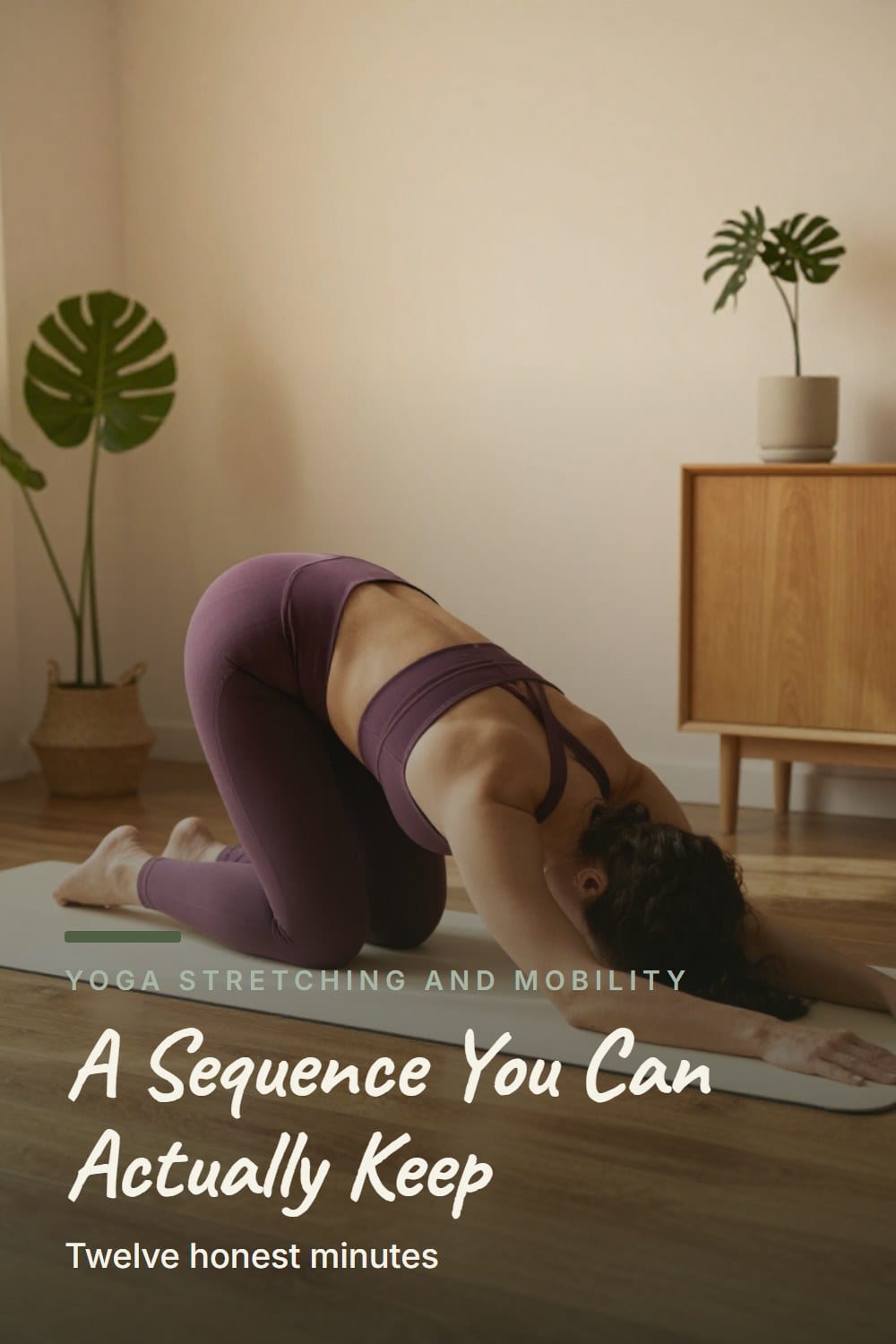
That whole sequence runs about twelve honest minutes. Some mornings you'll only get through half of it, and that still counts.
None of this is a diagnosis or a promise about your particular joints, hips or spine — only what the research generally supports, cited plainly below so you can read it yourself instead of just trusting me.
Where this comes from
Every claim above traces to one of these five.
- 1Harvard-Led Study: Yoga Fights Frailty
Harvard Health · 2023
Supports: That a review of 33 studies with nearly 2,400 participants over 65, led by Harvard-affiliated researchers at Brigham and Women's Hospital and published in Annals of Internal Medicine, found that people who practiced yoga improved on two markers of frailty — walking speed and the ability to get up from a chair — compared with those who didn't practice yoga, with walking speed showing the strongest association.
- 2The Physical Benefits of Yoga
Harvard Health
Supports: That yoga can increase flexibility and muscle strength and improve range of motion, which is part of why it's associated with reduced back and joint pain, with moderate evidence for long-term effectiveness specifically for chronic low-back pain.
- 3Unusual Symptoms of Perimenopause and Low Estrogen
Cleveland Clinic · 2025
Supports: That estrogen helps protect your joints, so lower estrogen levels can bring joint pain or discomfort, along with general inflammation and soreness, throughout the body during perimenopause.
- 4Strong, Steady and Straight: UK Consensus Statement on Physical Activity and Exercise for Osteoporosis
British Journal of Sports Medicine · 2022
Supports: That movements involving sustained, repeated or end-range spinal flexion — and any exercise that curves the back excessively, especially under added load — should be modified or avoided for people with osteoporosis, that smooth and comfortable rotation is generally considered safe, and that professional guidance matters, especially soon after a painful vertebral fracture.
- 5Yoga Spinal Flexion Positions and Vertebral Compression Fracture in Osteopenia or Osteoporosis of Spine: Case Series
Pain Practice · 2013
Supports: That vertebral compression fractures developed in patients with reduced bone density after they began yoga-associated spinal flexion exercises, and that such flexion exercises should not be prescribed for patients with spinal osteoporosis.
Free, and printable
The free 4-Week Indoor Walking Plan
The plan sign-up is not live yet — the mailing list is still being set up. In the meantime, email hello@strongandrooted.com and Diane will send it to you herself.
One email when there is something worth sending. Unsubscribe whenever you like.
Frequently asked questions
Is gentle yoga enough on its own, or do I need other exercise too?
What's the actual difference between gentle yoga, restorative yoga and chair yoga?
Is chair yoga a real workout, or just a modification for people who can't do 'real' yoga?
Is gentle yoga safe if I have osteoporosis or a history of a fracture?
Gentle yoga earns a real place in a low-impact week — not because it's peaceful, though it is, but because a Harvard-affiliated review found genuine capability gains from it in people well past 65. It was never meant to do everything, though. If bone density is what's actually on your mind, exercises for bone density after 40 is built for that specifically, and if it's strength, strength training for beginners over 40 is where to start. For the rest of what low-impact movement can do for you, the complete low-impact and mobility guide is the place to keep browsing.
Free, and printable
The 4-Week Indoor Walking Plan
The plan sign-up is not live yet — the mailing list is still being set up. In the meantime, email hello@strongandrooted.com and Diane will send it to you herself.
One email when there is something worth sending. Unsubscribe whenever you like.
Written by
Diane Marsh
At 49 I was tired, achy, sleeping badly, and being told to do more cardio and eat less — which was making all of it worse. I started walking. Fifteen minutes, indoors, in socks. Three years later I am stronger than I was at forty. I write down exactly what I did, cite the research where it exists, and admit where it doesn't.
Diane is not a doctor, a physical therapist, or a dietitian. She is a woman who rebuilt her own strength after perimenopause, reads the research carefully, cites it, and says so when nobody actually knows.
Keep reading
Stretching the same tight spot for months without any change isn't a discipline problem — it's usually the wrong tool for the job. Here's the honest reframe: why 'tight' often means unsupported, not short, what stretching genuinely does for you, the gentle routine that helps it stick, and the real fix for when stretching alone hasn't worked.
The 5-Minute Morning Mobility Routine for Women Over 40Five minutes, before coffee, in your pajamas, no mat required. Here's the honest, physical reason your mornings feel stiff after 40, the exact minute-by-minute routine I actually do, and the one stretch to swap out if you have osteoporosis.
Pilates for Your Back and Core After 40 (Without the Crunches)Core work doesn't mean crunches — and after 40, that distinction actually matters. Here's what your core really is, why the sit-ups you learned may be the least useful (and, for some of us, the riskiest) exercise on the list, and what Pilates offers instead: bracing, breathing, and learning to hold still.