Balance Exercises for Women Over 50 (The Steadiness Work Nobody Assigns You)
Nobody ever assigns you a balance routine — not your doctor, not your fitness app — so it quietly slides off the list while everything else gets attention. Here's the honest reframe: balance is a trainable skill, not a symptom of turning 50, and now is exactly the right time to start. Six ordinary moves, a kitchen counter, and the research behind why it's worth five minutes.

By Diane Marsh··10 min read
Claims on this page are checked against the CDC, NIAMS (part of the National Institutes of Health), the Cochrane Database of Systematic Reviews, and the British Journal of Sports Medicine's Strong, Steady and Straight expert guide — all four sources are linked below.
General education, not medical advice. Talk to your doctor before starting something new.
The short version
- Balance isn't something you lose for good — it's a skill, and skills respond to practice, the same way strength does.
- About 1 in 4 adults over 65 report a fall each year — worth knowing calmly, not something to panic over.
- Balance and functional exercise, done consistently, is linked to a 24% lower rate of falls in research on thousands of older adults.
- The six-move routine below needs no equipment — just a kitchen counter and about the time it takes to boil a kettle.
- Strength backs up balance: weak legs can't catch a stumble, so the two are worth training together.
Nobody ever sits you down and teaches you to balance. You learned it once, as a toddler, and everyone quietly assumed the job was finished for good.
It isn't. Balance is a skill like any other, and here's the reframe worth sitting with: this was never an old-lady topic. It's a trainable one — and fifty is exactly the right age to start training it, while it's easy and nothing about it feels urgent yet. Nobody ever assigns you a refresher course, so most women don't think about it again until a stumble makes them.
Why Nobody Ever Hands You This List
Your doctor checks your blood pressure and asks about your cholesterol. Your fitness app counts your steps and reminds you to close your rings. Almost nobody hands you an actual balance routine.
That's not because it doesn't matter. It's because it doesn't have an obvious owner — not urgent enough for a fifteen-minute appointment, not flashy enough for a push notification. So it quietly slides down the list, year after year, until something makes it impossible to ignore. This is the article that puts it back on your list before that happens.
The Number That's Easy to Scroll Past
Here's a number worth sitting with for a second, not panicking over.
That statistic has exactly one job in this article: explaining why balance training belongs on the same list as your walks and your strength days, instead of the list you get to eventually. It isn't a warning designed to scare you into anything.
Why This Lands a Little Differently for Women
There's a reason this conversation is worth having as a woman specifically, and it isn't about being fragile. It's about bone.
Put those two things together and here's the honest, unfrightening version: a stumble that leaves one person bruised can, for someone with lower bone density, end differently. That's not a reason to eye your own kitchen floor with suspicion. It's the reason the next part is actually good news.
Here's the Actually Good News
This is the part that almost never makes it into the scary version of this topic: balance training works, and it works in a way researchers have actually measured.
Twenty-four percent, from consistent practice, in research that specifically tracked the rate of falls — not a guess, not a marketing claim. The UK's own bone-health and physical therapy experts organized their national exercise guidance for osteoporosis around three words: Strong, Steady and Straight. Strong is resistance and impact work for bone. Straight is posture work for your spine. Steady — the one this article is entirely about — is balance and strength training, recommended at least a couple of times a week.
We cover the Strong side of that in our bone-density guide, and the Straight side in our posture piece. This one is entirely about Steady.
Balance Is a Skill, and Skills Respond to Practice
Here's what makes this genuinely easy to like, once you get past the scary framing: balance is one of the fastest, lowest-cost things you can train.
It doesn't need a gym membership, a piece of equipment, or a special outfit. It needs a kitchen counter, a sturdy chair, and about the amount of time it takes a kettle to boil.
- While the kettle boils or the coffee brews
- While you brush your teeth, morning or night
- While you wait for the shower water to run hot
- While something's got sixty seconds left in the microwave
The Steadiness Routine
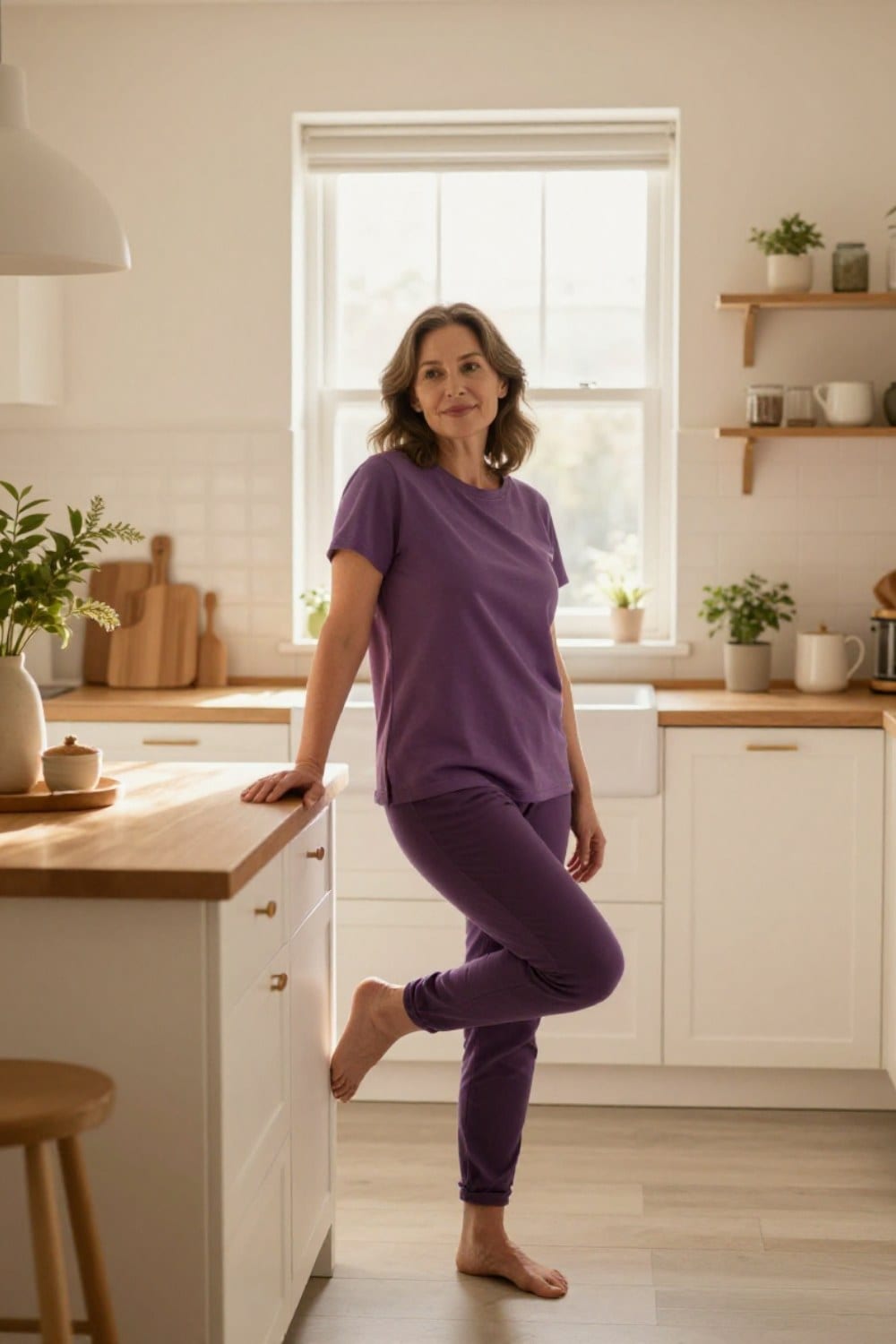
Six ordinary moves, done near a counter or a sturdy chair, most days if you can manage it. None of it requires you to be good at it on day one — the wobble is the whole point. It's what tells your brain and your muscles there's a job to do. Here's what that job tends to feel like week to week: the first few days are genuinely wobbly, sometimes more than you'd expect from something this simple. Some women notice a difference within the first week or two — not perfect balance, just less bracing, less grabbing for the counter out of reflex. By three or four weeks into the routine, it stops feeling like a task you're gritting through and starts feeling like something your body already knows how to do. That's not the wobble disappearing entirely — it's your brain and your ankles finishing a conversation they'd stopped having for a while.
Your Steadiness Routine
Do these near a counter or the back of a sturdy chair, especially the first few times you try each one.
| Move | How Long | How It Should Feel | Easier Version |
|---|---|---|---|
| Single-Leg Stand | 20–30 seconds a side | Wobbly at first, steadier by the end of the week | Both hands lightly on the counter the whole time |
| Heel-to-Toe Walk | 10 steps in a line | Like a balance beam — slower and more focused than it looks | One hand trailing along the counter or a wall |
| Sit-to-Stand (No Hands) | 8–10 reps | Your thighs will let you know it's working | Push up from the arms of a sturdy chair |
| Single-Leg Reach | 6–8 reaches a side | A gentle wobble through your standing hip and ankle | Lift the back leg just an inch instead of reaching |
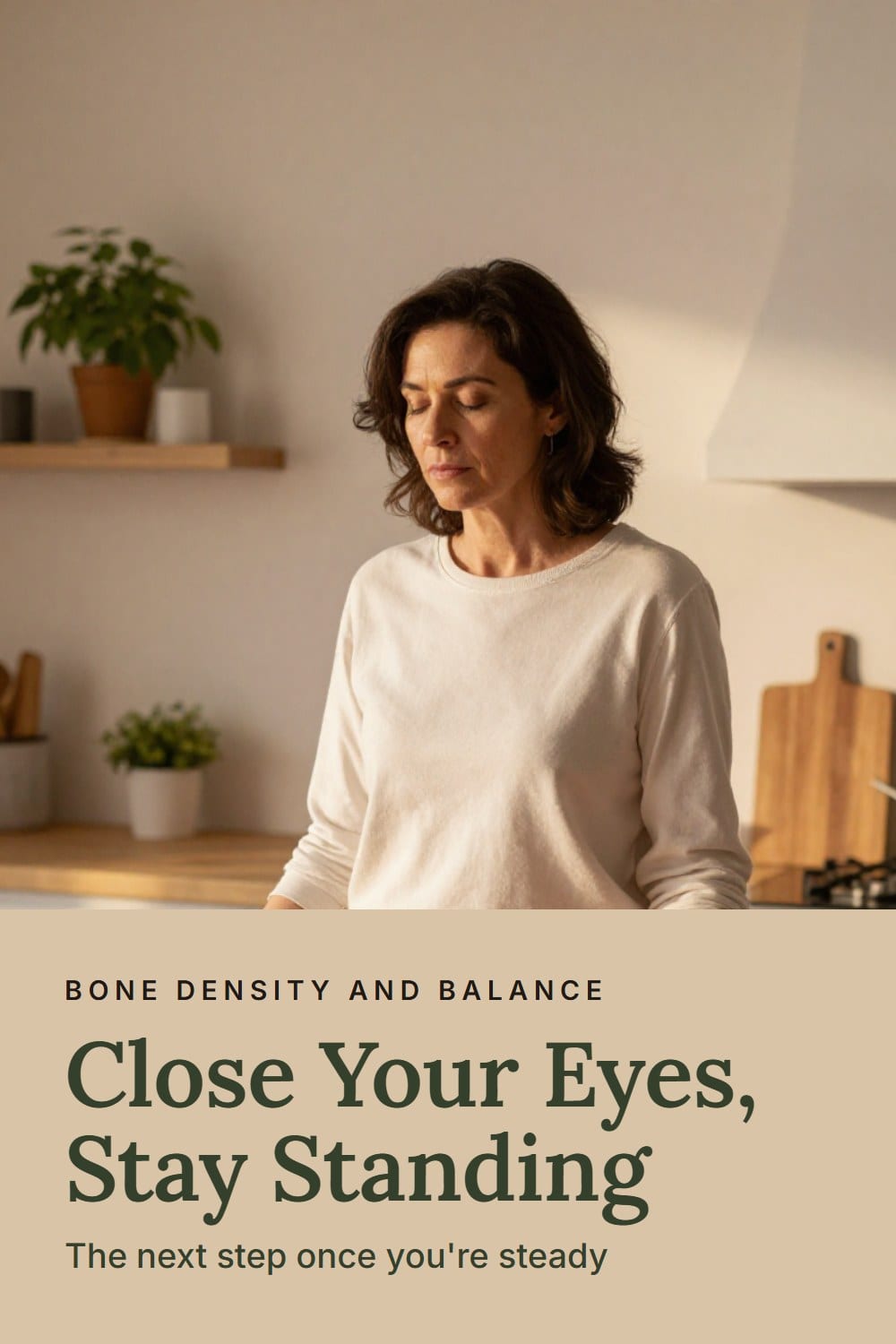
| Eyes-Closed StandAlways at the counter for this one, hands ready, not just nearby. | 10–15 seconds a side | Stranger than you'd expect — your eyes do more balance work than you'd think | Keep your eyes open, same stance |
| Step-Ups | 8–10 a side on a low step or stair | Like climbing, focused and controlled | Hold the railing or a counter with one hand |
Strength Is Half of Balance
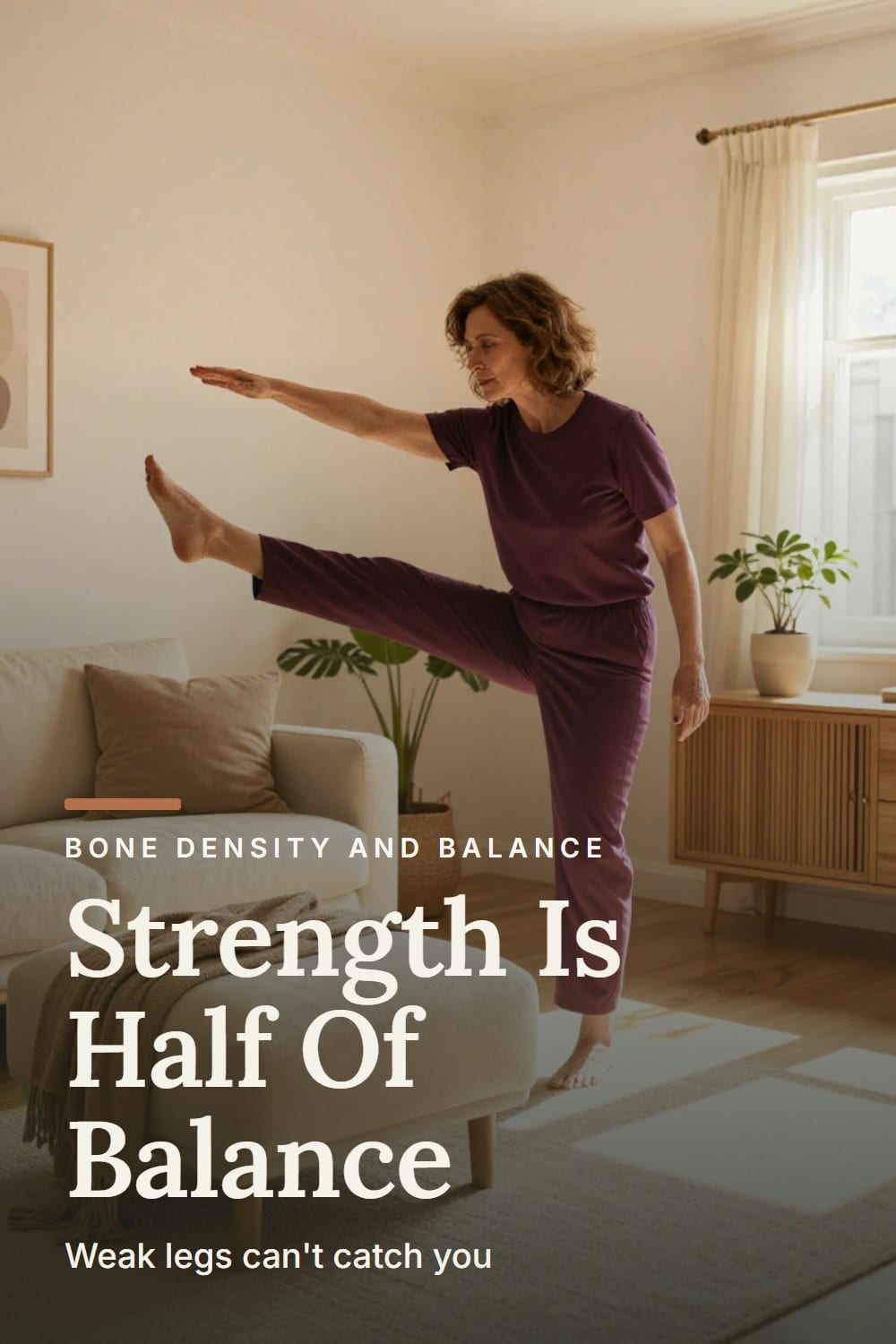
Balance training on its own is genuinely useful. But it's only half of this, and it's worth being honest about the other half: you can't catch yourself with legs that can't push. When you actually start to tip, there's no time to think your way back — your body has a split second to react, and that reaction needs real strength behind it or it simply won't be fast enough to catch you.
The strength to catch a stumble or push yourself back upright comes from the same strength work that supports your bone and muscle in general — not from balance drills by themselves. If you haven't started that side yet, our beginner strength guide is the natural next stop, and this no-equipment routine asks even less of your schedule than the moves above.
If you already walk regularly, here's how walking and strength fit into the same week without turning your schedule into a second job. And if you want the full picture of what strength and muscle after 40 actually covers — bone, balance and posture, all in one place — the complete guide ties it together.
None of this is a diagnosis or a promise about your own balance specifically. It's general education, cited plainly below so you can check it yourself instead of just trusting me.
Where this comes from
Every claim above traces to one of these four.
- 1Nonfatal and Fatal Falls Among Adults Aged ≥65 Years — United States, 2020–2021
CDC (Morbidity and Mortality Weekly Report) · 2023
Supports: That an estimated 14 million (27.6%) of U.S. adults 65 and older reported falling at least once in the previous year, and that a higher percentage of women (28.9%) than men (26.1%) reported a fall.
- 2Osteoporosis Causes, Risk Factors, & Symptoms
NIAMS (National Institutes of Health)
Supports: That osteoporosis is more common in women than men, that women have lower peak bone mass and smaller bones than men, and that osteoporosis is a major cause of fractures of the hip, spine and wrist.
- 3Exercise for Preventing Falls in Older People Living in the Community
Cochrane Database of Systematic Reviews · 2019
Supports: That compared with a control group, balance and functional exercise programs are associated with a 24% lower rate of falls in older adults (0.76 times the rate; 39 studies, 7,920 participants; high-certainty evidence).
- 4Strong, Steady and Straight: UK Consensus Statement on Physical Activity and Exercise for Osteoporosis
British Journal of Sports Medicine · 2022
Supports: That the expert guide organizes osteoporosis exercise guidance around three aims — resistance and impact exercise for bone strength (Strong), balance and strength training to reduce falls (Steady), and spinal extension exercise for posture (Straight) — with balance training recommended at least twice a week.
Free, and printable
The Free 4-Week Indoor Walking Plan
The plan sign-up is not live yet — the mailing list is still being set up. In the meantime, email hello@strongandrooted.com and Diane will send it to you herself.
One email when there is something worth sending. Unsubscribe whenever you like.
Frequently asked questions
How long until my balance actually improves?
Do I need any equipment to do these exercises?
I already have osteoporosis or low bone density. Is this routine safe for me?
What if I feel dizzy or unsteady doing these?
Balance isn't a symptom of getting older — it's a skill, and skills respond to whoever keeps showing up for them. If you haven't built the bone-and-muscle foundation underneath it, start with our beginner strength guide or this no-equipment routine. If you already have, just add the six moves above to a morning you already own. Some mornings it'll feel easy and some it won't, and neither one is a verdict on how you're doing overall. However you get there, steady is its own kind of strong.
Free, and printable
The 4-Week Indoor Walking Plan
The plan sign-up is not live yet — the mailing list is still being set up. In the meantime, email hello@strongandrooted.com and Diane will send it to you herself.
One email when there is something worth sending. Unsubscribe whenever you like.
Written by
Diane Marsh
At 49 I was tired, achy, sleeping badly, and being told to do more cardio and eat less — which was making all of it worse. I started walking. Fifteen minutes, indoors, in socks. Three years later I am stronger than I was at forty. I write down exactly what I did, cite the research where it exists, and admit where it doesn't.
Diane is not a doctor, a physical therapist, or a dietitian. She is a woman who rebuilt her own strength after perimenopause, reads the research carefully, cites it, and says so when nobody actually knows.
Keep reading
Bone is living tissue, and it responds to real load — that's the hopeful, honest mechanism behind this entire guide. Here's what the guidelines actually recommend for bone density after 40: the loading intensity almost nobody explains honestly, the real limits of walking and a weighted vest, and the one thing to skip entirely if you already have a diagnosis.
Strength & Muscle After 40: The Complete GuideAlmost nobody tells you the whole territory in one place — why it's not too late to build real strength after 40, what muscle actually protects (it was never about looks), the honest map of how to start, and the one safety rule that matters more than all the rest.
Bodyweight Strength Training After 40 (No Equipment, Anywhere)You don't need a gym bag, a suitcase of dumbbells, or a single new purchase to start building real strength after 40. Your own bodyweight is a genuine load — and your dining chair is a real squat rack. Here's the honest, no-equipment routine, and five ways to keep it working without adding a single pound.