Self-Care That Isn't a Bubble Bath (What Actually Holds a Midlife Decade Together)
Self-care got sold to her as something she buys, earns, and does once a quarter, right before going back to the exact week that emptied her out. The honest version is smaller and a lot less photogenic: sleep she protects, food that holds her up, movement most days, strength twice a week, and a no said on purpose. The bath is still lovely. It just isn't the plan.

By Diane Marsh··10 min read
Claims on this page are checked against Harvard Health Publishing, Cleveland Clinic and the CDC — all five sources are linked below.
General education, not medical advice. Talk to your doctor before starting something new.
The short version
- The self-care that actually changes a midlife decade isn't a candle or a spa day — it's boring, repeatable and mostly free: sleep, food, movement, strength, and the word no.
- A bath is genuinely lovely. It's just not a plan — those are two different, both-true things.
- You don't have to earn rest by finishing your list first. Rest is part of how the rest gets done, not the prize for doing it.
- Saying no is the self-care nobody sells you, because there's nothing in a cart to ring up — just a sentence, said before you're already depleted.
- On a low-energy day, the honest minimum still counts: one minute of slow breathing is the real thing, not a smaller version of it.
Somewhere along the way, "self-care" turned into a noun you buy. A candle. A face mask. A spa day you book once a quarter, right when you're already running on fumes — and then it's Monday again, and the week that emptied you out is still exactly the same week.
Here's the thing nobody selling you a bath bomb wants said out loud: none of that is wrong, exactly. It's just not the thing that's supposed to be doing the actual work. If you've bought the candle, taken the bath, and still felt just as depleted by Wednesday, that's not a personal failure. That's the marketing working exactly as designed.
How "Self-Care" Turned Into Something You Buy
The phrase didn't start out as a purchase. Decades ago, it showed up in medicine and in activism — a way of naming the basic upkeep a body and a nervous system need to keep functioning under real strain, not a prize for good behavior. Audre Lorde, writing while sick and worn down from a life of real fights, put it about as plainly as it's ever been said:
Caring for myself is not self-indulgence, it is self-preservation.— Audre Lorde
Preservation, not a purchase. Somewhere between then and your Pinterest feed, a genuinely useful idea got repackaged into a product category — because a candle is a lot easier to sell you than "protect your sleep" or "say no more often." Nobody makes money off you simply going to bed on time.
A Bath Is Lovely. It Isn't a Plan.
Let's be completely clear before we go any further, because this is where a lot of writing on this subject quietly turns mean: there is nothing wrong with a bubble bath. If a hot bath, a good book, and twenty quiet minutes with the door closed sounds wonderful to you tonight, it is wonderful. Go take it.
Both things are true at once, and neither one cancels out the other. A bath is a genuinely lovely twenty minutes. It's also not a plan for a decade of your life — the same way one great dinner isn't a nutrition plan, and one good walk isn't a fitness routine. The bath was never the problem. It's that the bath got sold to you as the whole job, instead of one pleasant, occasional part of a much more ordinary one.
The Actual List (Boring, Repeatable, Free)
Here's the honest version, and fair warning: it doesn't photograph well. Nothing on this list fits in a gift box. The self-care that actually changes how your 40s or 50s feel is unglamorous, it repeats every single day whether you feel like it or not, and almost none of it costs anything at all.
What Gets Sold vs. What Actually Holds You Up
A side-by-side, because the marketed version and the actual version are almost never the same five minutes.
| Sold As Self-Care | What It Actually Costs You | What Actually Does The Job | Where To Start | |
|---|---|---|---|---|
| The Bath & Candle Ritual | A hot bath, a candle, maybe a bath bomb — genuinely lovely, genuinely occasional | An evening, and something to buy — worth it, but it's a once-in-a-while event, not a Tuesday habit | Protecting your sleep window most nights, not just after the one rough one | Pick one wake-up time and hold it for a week straight |
| The Quarterly Spa Day | A facial, a massage, a full day out of the house | A real day off and a real bill, maybe once or twice a year | Ten minutes of movement on most days, whether or not it counts as a workout | A walk around the block, most days — it counts completely |
| The Self-Care Haul | A cart full of skincare, a journal, a candle, a set of oils | Real money out the door, and a drawer they mostly end up sitting in | Food that actually holds you steady between meals | One breakfast with real protein in it, most mornings |
| The Wellness App Subscription | A meditation or mindfulness app, downloaded with real intentions | A monthly charge and a streak that quietly breaks by week three | Strength work, twice a week, even the short version | Two 15-minute sessions on the actual calendar, not just 'sometime this week' |
| Clearing The Whole Day | Canceling everything and doing nothing, for one full day | A day off the calendar, and often more worry about what's now piling up | The word no, said out loud, before you're already running on empty | One thing you decline this week — on purpose, ahead of time |
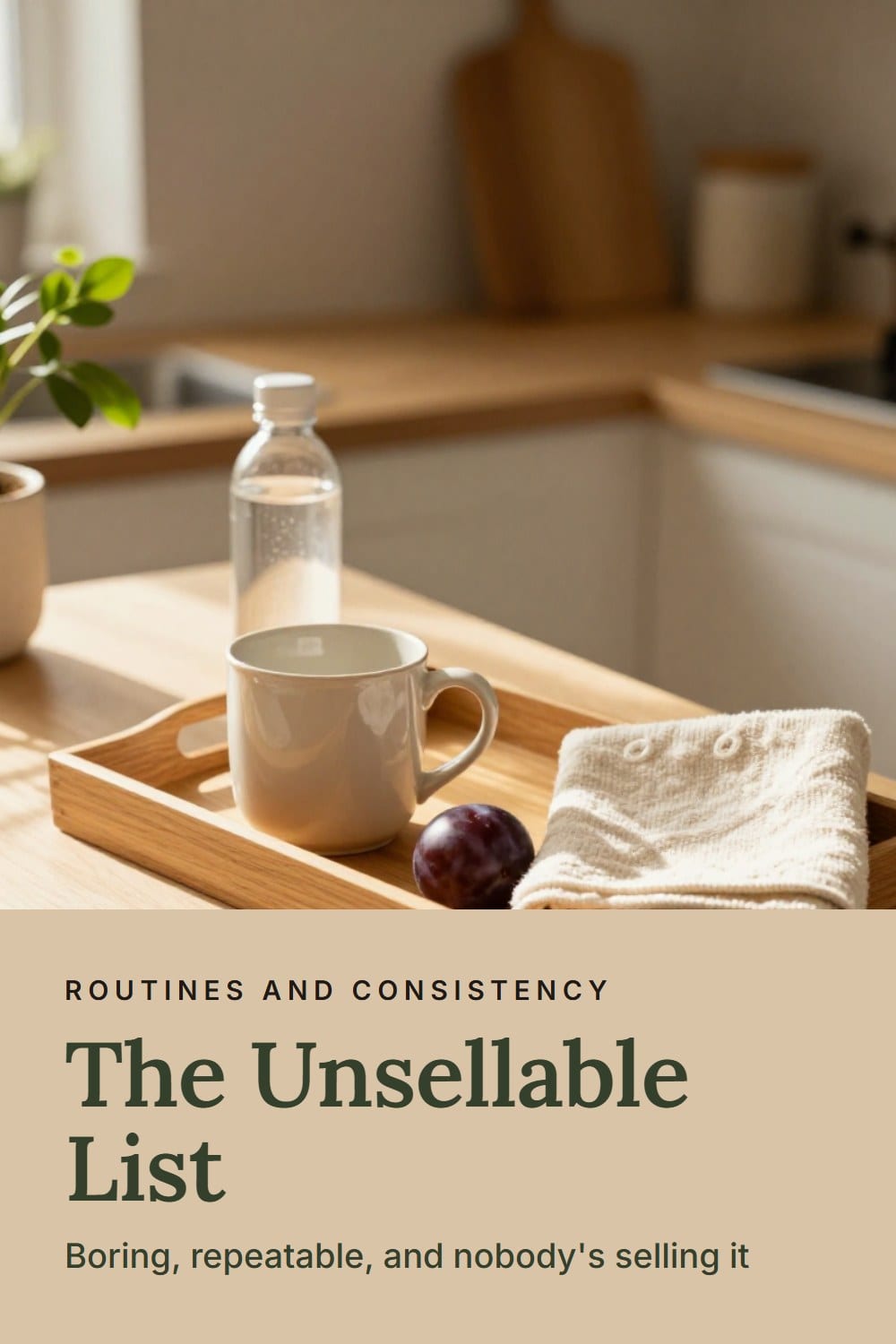
Stack that right-hand column together, day after day, and you've basically built the daily wellness routine I've laid out in full elsewhere — this is the same list, just with the marketing stripped off it.
Sleep, Food, Movement, Strength — In That Order, Honestly
Sleep goes first because it's doing a lot of the actual repair work on this list, especially once night sweats and 3 a.m. wake-ups get involved. I've written the fuller, cited version of that fight separately, and if you want the whole sleep-stress-recovery picture in one place, the complete guide is here. For now, just know that protecting it counts as real self-care, even on the nights it feels like a losing battle.
Food that holds you up doesn't need to be a project — it usually just means breakfast has something besides sugar in it, most days. Movement doesn't need a studio membership, either; a walk most days does real, measurable work. Strength is the one people skip first, and miss the most.
No Is Self-Care (Nobody Sells It, Because There's Nothing to Ring Up)
Here's the item on the list that never makes it into a gift box: the word no. Nobody's built a subscription around it, because there's genuinely nothing to sell you — just a sentence you say out loud, before you're already too depleted to say it well.
That's probably exactly why it gets left off most self-care lists. It doesn't photograph, it doesn't ship, and it can feel a little uncomfortable the first few times you say it out loud. It's also one of the few things on this whole list backed by an actual clinical case, not just a nice idea.
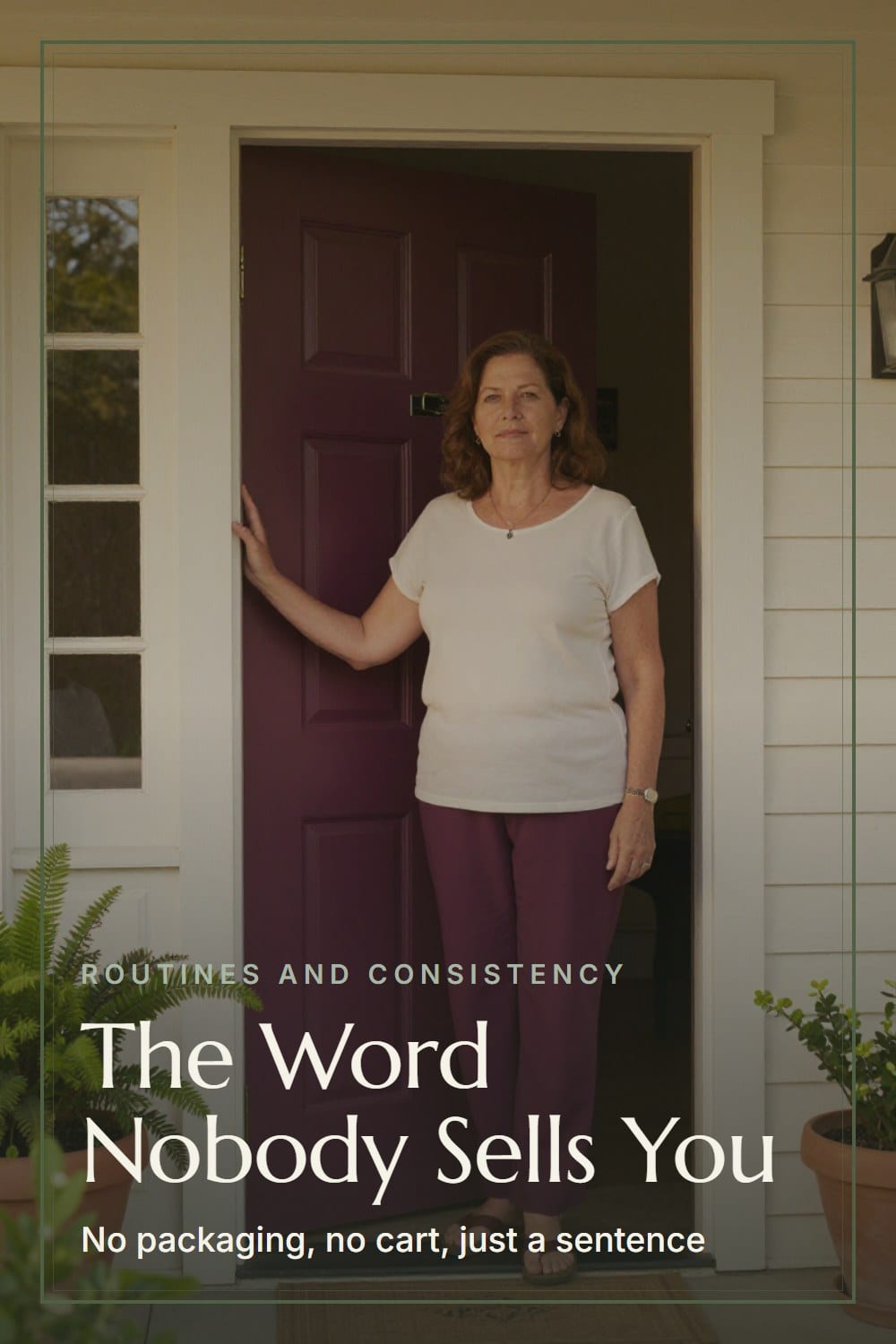
If you want to actually sit down and sort out what has to go versus what you're just carrying out of habit, I've walked through that exact exercise separately — here's the short version: saying no, on purpose, before you're empty, is doing real work. Nobody needs to sell it to you for that to be true.
You Don't Have to Earn Rest
Here's the single most useful sentence in this whole article, so I'll put it by itself: you don't have to earn rest. Not by finishing the list first. Not by having a hard enough week first. Not by anything.
None of this works as one grand decision, either — it works the same boring way any consistent habit works: small, repeated, stacked onto a day you already have, not a separate life you're supposed to build around it.
Ten Minutes and No Energy? Here's the Honest Minimum
Some days the list above is genuinely too much, and that's real, not an excuse. On those days, the goal isn't the full version of anything. It's the smallest real version you can actually manage.
- One minute of slow breathing — in for a count of three, out for a count of three.
- Both feet on the floor, shoulders dropped, for ten slow breaths.
- A glass of water and five minutes sitting somewhere that isn't your kitchen counter.
- One honest text to someone who actually knows what your week looks like.
- Lights off ten minutes earlier than last night. That's it. That's the whole assignment.
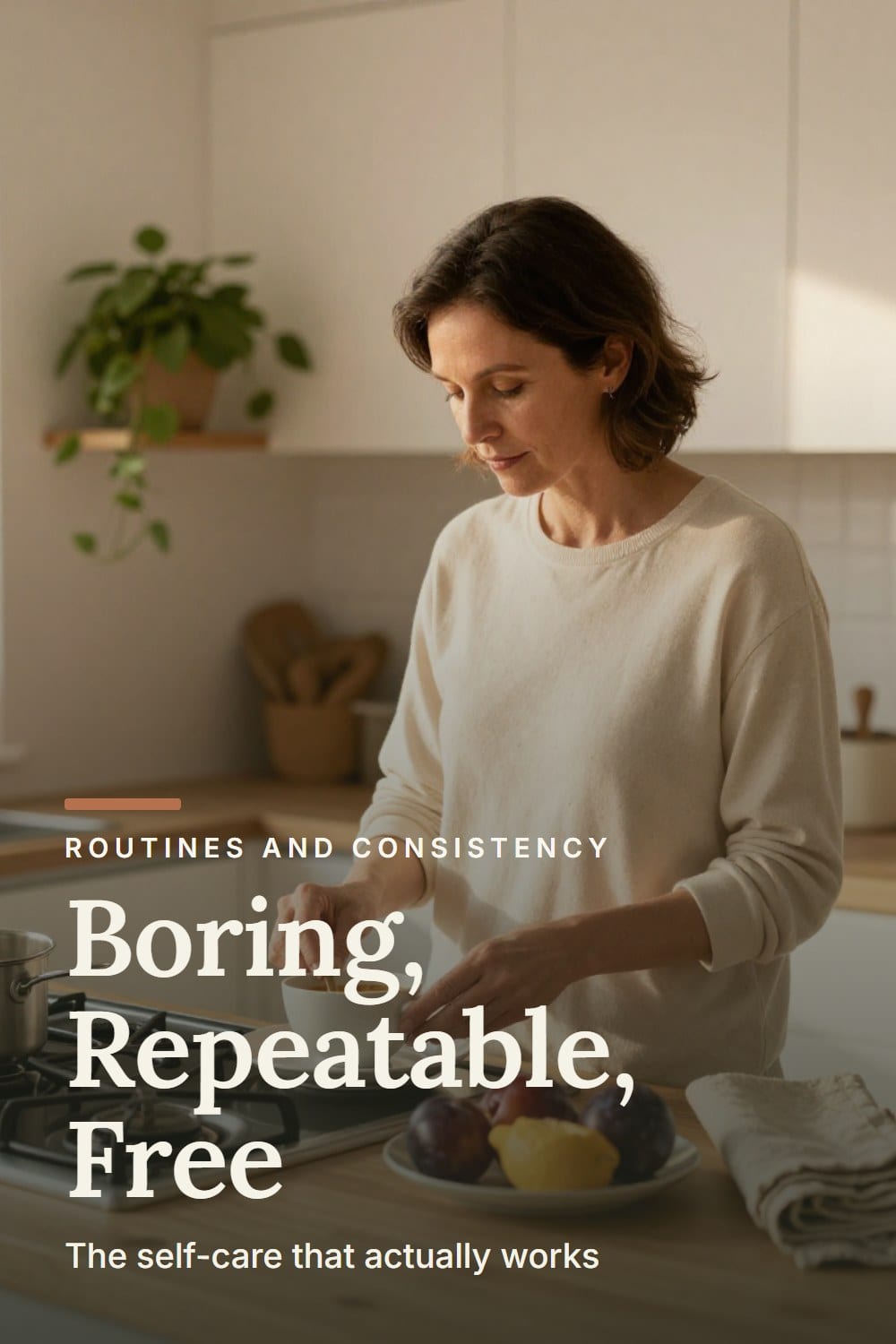
That list above is genuinely the whole minimum — not a smaller, sadder version of self-care. The real thing, sized to the day you're actually having.
None of that is a study — it's one woman's honest ledger, and yours may look completely different. The pattern underneath it is common enough that I'd rather tell you about it than leave it out.
Free, and printable
The Free 4-Week Indoor Walking Plan
The plan sign-up is not live yet — the mailing list is still being set up. In the meantime, email hello@strongandrooted.com and Diane will send it to you herself.
One email when there is something worth sending. Unsubscribe whenever you like.
None of this is a diagnosis, and it isn't a promise about your specific week — only what the research and the people who study this for a living actually say, cited plainly below so you can check it yourself instead of just trusting me.
Where this comes from
Every claim above traces to one of these five.
- 1Self-Care: 4 Ways to Nourish Body and Soul
Harvard Health Publishing · 2017
Supports: That real self-care is defined as paying attention to and supporting your own physical and mental health through ordinary daily habits — being physically active in any amount, eating reasonably well, calming your mind, and getting enough sleep — not pampering or a purchase.
- 2Adult Activity: An Overview
CDC
Supports: That the general guideline for adults is muscle-strengthening activity on at least 2 days a week, covering all major muscle groups.
- 3How To Set Boundaries in Healthy Ways
Cleveland Clinic · 2026
Supports: That skipping boundaries makes it easy to overextend yourself, feel resentful, or lose sight of your own needs, and left unchecked can lead to real exhaustion and burnout — and that setting boundaries is a legitimate form of self-care, not selfishness.
- 49 Strategies To Stop Procrastinating
Cleveland Clinic · 2026
Supports: Clinical psychologist Dr. Becky Bikat Tilahun's statement that rest is not a reward, it's required for productivity, and that a mentally or emotionally depleted brain naturally avoids effortful tasks.
- 5Mini-Relaxation Exercises: A Quick Fix in Stressful Moments
Harvard Health Publishing · 2012
Supports: That short relaxation exercises lasting one to three minutes — slow counted breathing, or systematically relaxing the face, shoulders and hands while seated — can measurably ease stress in the moment, with no equipment and very little time required.
Frequently asked questions
Is it wrong to enjoy a bubble bath or a spa day?
What actually counts as self-care if not the marketed version?
Do I have to earn rest by finishing everything on my list first?
What if I only have ten minutes and no energy at all?
Self-care that actually changes a midlife decade was never going to be a candle. It's sleep you protect on ordinary nights, food that holds you up, movement most days, strength twice a week, and a no you say before you're empty — boring, repeatable and free, every single time. Enjoy the bath anyway. Just don't mistake it for the plan. For the fuller picture of everything in this category, the complete guide is a good next stop.
Free, and printable
The 4-Week Indoor Walking Plan
The plan sign-up is not live yet — the mailing list is still being set up. In the meantime, email hello@strongandrooted.com and Diane will send it to you herself.
One email when there is something worth sending. Unsubscribe whenever you like.
Written by
Diane Marsh
At 49 I was tired, achy, sleeping badly, and being told to do more cardio and eat less — which was making all of it worse. I started walking. Fifteen minutes, indoors, in socks. Three years later I am stronger than I was at forty. I write down exactly what I did, cite the research where it exists, and admit where it doesn't.
Diane is not a doctor, a physical therapist, or a dietitian. She is a woman who rebuilt her own strength after perimenopause, reads the research carefully, cites it, and says so when nobody actually knows.
Keep reading
Every October, the internet sells you a countdown to a smaller body by the holidays. Here's a different one: eight to ten weeks to a body that can carry every bag in one trip, breeze through travel, and still have energy at nine at night. Strong, not skinny — that's the whole plan.
Strong by Summer: An Energy Plan, Not a Swimsuit PlanEvery spring, the same message shows up: a body you're supposed to want by a certain date. This is a different plan — eight to ten weeks built around the energy and capability you actually want this summer: walking the beach, keeping up on the hike, carrying the cooler, saying yes to the trip. Not one part of it is about how you'll look.
A New Year Reset for Women Over 40 (Without the Crash Diet)For thirty Januarys, the deal has been the same: fix yourself, starting now, no exceptions. Here's the honest alternative — keep the fresh start, skip the crash diet, and build something small enough to actually survive a real winter Tuesday. Two anchors, not twelve rules, and the research on why day 21 was never a fair place to judge yourself.