Stress Management for Midlife Women (When You Can't Just Remove the Stress)
Every stress article tells her to reduce it. She can't — not with the parents, the job, and the body she has this year. Here's what to do instead: build the buffer, spend the free levers well, and know the honest difference between stress and something more.

By Diane Marsh··11 min read
Claims on this page are checked against The Menopause Society, Harvard Health, the CDC, NHLBI and NIGMS (both part of NIH), and a peer-reviewed study in the Journal of the American Geriatrics Society — all sources are linked below.

General education, not medical advice. Talk to your doctor before starting something new.
The short version
- You can't remove a genuinely overloaded midlife — the load is real, and your buffer runs thinner right now, too.
- The best-supported levers are boring and free: movement, daylight, sleep, connection with other people, and time outdoors.
- Some of what's on your plate actually has to come off it. You cannot self-care your way out of an overloaded life — that part is arithmetic, not attitude.
- Five minutes is a real dose on the days that's all you have — not a smaller, lesser version of trying.
- Exhaustion that doesn't match your hours, or a low mood that won't lift, is worth a doctor's conversation — not a character failure.
Somewhere along the way, almost every stress article gives you the same instruction: reduce your stress. Simplify your life. Say no more often. It's well-meaning advice, and for a lot of women in midlife, it's also nearly useless.
You didn't choose the parent who needs you now, the job that isn't getting lighter, or a body that suddenly has opinions about how much you can absorb. Most of what's stressing you out this year isn't optional, and it isn't going anywhere soon. So this isn't an article about removing your stress. It's about what you do when the load itself is fixed — building your capacity to carry it, and spending what you do control as well as you possibly can.
Why Midlife Stress Doesn't Play By The Old Rules
Here's something worth saying plainly: if stress feels different at 50 than it did at 30, that's not in your head. Two things are happening together — the demands on you have often gotten heavier, not lighter, and the systems that used to help you bounce back are running with less cushion than they used to.
That's the load side. The other half is quieter, and just as real: for a lot of women, the body's own recovery systems — sleep especially — get less dependable in the very years the load tends to go up. That's an unlucky coincidence, not a flaw in you.
None of that means you're broken, and none of it means one lever unwinds it. If 3 a.m. wide-awake is where this shows up most for you, here's the honest, sourced picture of what's actually happening then. This article is about the bigger daytime question: what actually builds your tolerance, and what to do with the hours you do control.
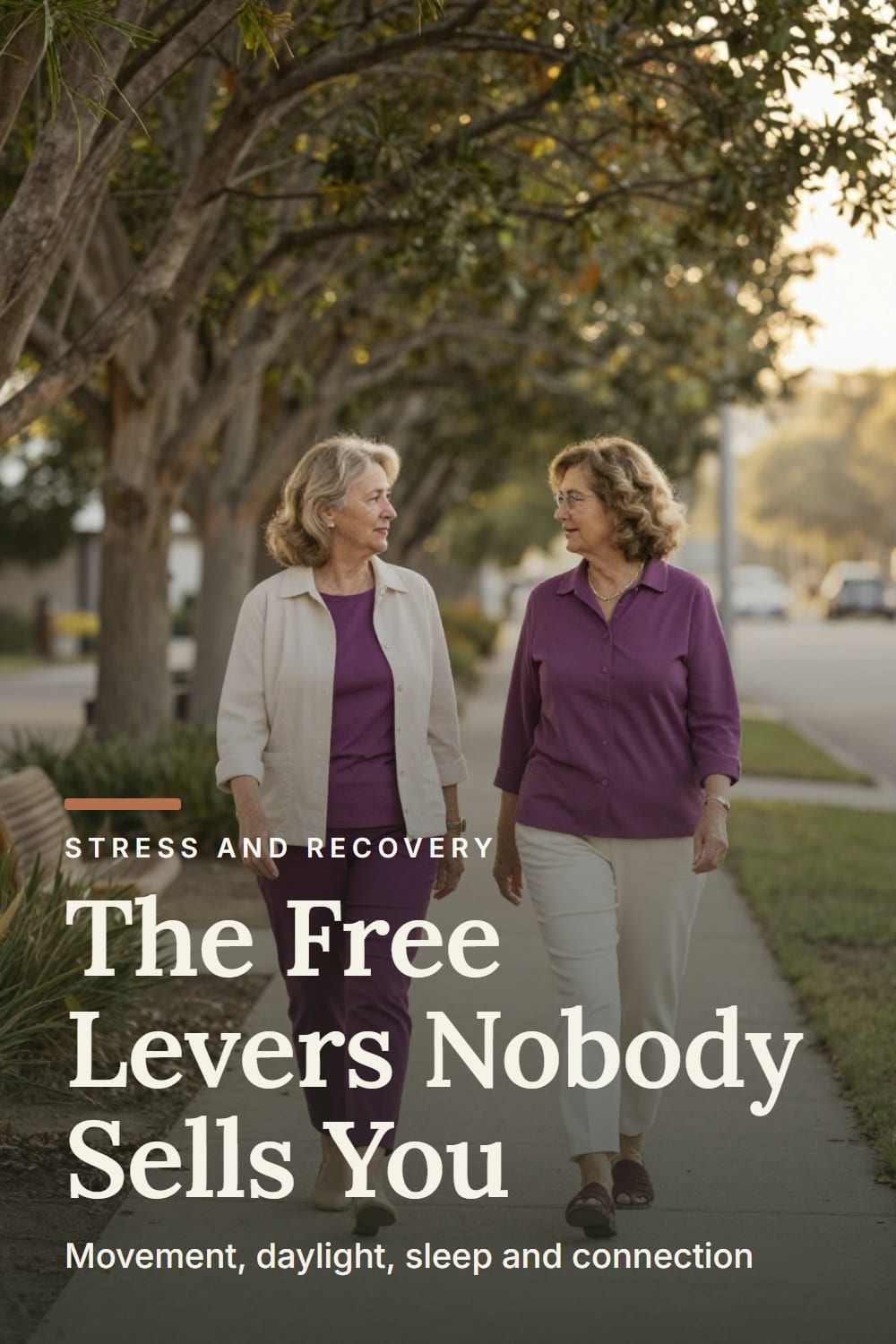
The Free Levers Nobody Sells You
The genuinely well-supported ways to build stress tolerance are almost insultingly ordinary. Nobody can put them in a bottle, which might be exactly why you've never seen them marketed with much enthusiasm. Here's where the real leverage actually is, plus a version that fits into five minutes on the days that's all you have.
Where The Real Leverage Actually Is
Five things with real support behind them — not a full routine, just where to put your attention first.
| Lever | What it actually does | The five-minute version | Where to start |
|---|---|---|---|
| Movement | Lowers stress hormones and raises the brain chemicals that steady your mood | A brisk walk around the block, or up and down your stairs a few times | A short daily walk you can defend even on hard days |
| Daylight | Sets your body's internal clock, which shapes both your mood and that night's sleep | Step outside, or sit by a bright window, before you're deep into your inbox | Morning light, ideally before 10 a.m. |
| Sleep | Restores the buffer that stress draws down every day | One consistent wake-up time, even after a rough night | The same wake time, seven days a week |
| Connection | Buffers the health effects of stress in ways solo habits can't quite match | One honest text or call with someone who actually knows what's going on | A standing weekly call, even ten minutes long |
| Time outdoors | Measurably lowers stress hormones, separate from the exercise itself | Ten minutes on a porch, a bench, or a patch of grass | Wherever green space or open sky is closest to your door |
A few of these are worth slowing down on, because the research behind them is more specific than ‘movement is good for you.’
If you don't have a regular walking habit yet, our free beginner walking plan is a no-equipment place to start — it's the same plan waiting for you at the end of this article, if you'd like it sent over.
None of this is a full plan. For the fuller daily version of all five, here's how we lay out a nervous-system-friendly day. On weeks the load doesn't ease up, giving yourself an honest rest day does more for your buffer than one more task added to your list.
The Honest Triage: What Has To Go, What You're Just Carrying
Here's the part most stress advice skips: some of what's on your plate has to come off it. The trick is telling the difference between what's genuinely required and what you're carrying purely out of habit.
Start with the honest ‘has to go’ list, at least for this season:
- The commitment you agreed to a year ago, for a version of you with more hours in the week.
- Anything you're doing purely so nobody's disappointed in you, with no other real benefit to anyone.
- The extra, unpaid work of managing everyone else's feelings about your situation.
- One recurring task you could delegate, automate, or simply drop, that you've never stopped to question.
And then there's the harder list — full of things that feel necessary but might just be familiar:
- The version of ‘a perfect house’ you inherited from somewhere, that nobody living in it is actually asking for.
- Checking in daily on people who are, genuinely, doing fine without it.
- The belief that rest counts only once everything else is finished.
- Saying yes fast, before you've asked whether you even have the five minutes it will cost you.
When It's More Than Stress
Everything above assumes what you're dealing with is stress — a genuinely heavy, ongoing load wearing you down the way heavy loads do. Sometimes it's that, plus something else layered underneath.
A low mood that doesn't lift even on the easier days, worry that doesn't let up regardless of what's actually happening, or feeling flat about things you'd normally enjoy — none of that is a character problem, and none of it is something you're supposed to simply try harder against. It's worth an actual conversation with your doctor, the same way a persistent physical symptom would be.
None of this is something to self-diagnose from an article, mine included. If you're not sure how to start that conversation, or whether what you're noticing is ‘enough’ to bring up, we've laid out exactly how to have that appointment, including what to say if you've been waved off before.
Feeling exhausted, anxious, or low isn't a failure of your coping skills. Sometimes it's the honest, physical cost of an overloaded year. Sometimes it's something else entirely, layered on top. Either way, it deserves a real answer, not another routine to try harder at.
None of this is a diagnosis, and it isn't a promise about what's going on with you specifically — only what the research supports, cited plainly below, so you can check it yourself instead of just trusting me.
Where this comes from
Every claim above traces to one of these.
- 1A National Profile of Sandwich Generation Caregivers Providing Care to Both Older Adults and Children
Journal of the American Geriatrics Society · 2023
Supports: That caregivers raising a child under 18 while also caring for an aging parent — the 'sandwich generation' — were more likely to report substantial financial difficulty (36% vs. 17%) and substantial emotional difficulty (44% vs. 32%) than caregivers who cared for a parent alone.
- 2Mental Health: Hormones, Mood & Anxiety
The Menopause Society
Supports: That estrogen receptors are present in brain regions involved in mood regulation and that big swings in estrogen during perimenopause are linked to mood symptoms, while stating plainly that the precise mechanism isn't known; and that women have roughly double the rate of depression during perimenopause and early postmenopause compared with other life stages.
- 3Exercising to Relax
Harvard Health Publishing · 2020
Supports: That exercise reduces levels of the body's stress hormones, such as adrenaline and cortisol, and stimulates production of endorphins, and that roughly 30 to 40 minutes of moderate exercise (or 15 to 20 minutes of vigorous exercise) is a reasonable target for stress relief.
- 4A 20-Minute Nature Break Relieves Stress
Harvard Health Publishing · 2019
Supports: That spending at least 20 to 30 minutes immersed in a natural setting was associated with the biggest drop in the stress hormone cortisol, measured through saliva samples before and after outdoor time, and that even shorter nature breaks showed a measurable benefit.
- 5Circadian Rhythms
National Institute of General Medical Sciences (NIH)
Supports: That light and dark have the biggest influence on the body's internal circadian clock, and that long-term disruption of circadian rhythms is linked to a higher risk of mood disorders, among other health effects.
- 6Health Effects of Social Isolation and Loneliness
CDC
Supports: That social isolation and loneliness increase a person's risk for depression and anxiety, among other health conditions, and that about 1 in 3 U.S. adults report feeling lonely.
- 7Sleep Apnea and Women
NHLBI (National Institutes of Health) · 2025
Supports: That women's risk for sleep apnea increases during and after menopause, and that because women may not have typical sleep apnea symptoms like snoring, they may not realize they have the condition — instead more commonly reporting daytime sleepiness, tiredness, morning headaches, and insomnia.
Free, and printable
The Free 4-Week Indoor Walking Plan
The plan sign-up is not live yet — the mailing list is still being set up. In the meantime, email hello@strongandrooted.com and Diane will send it to you herself.
One email when there is something worth sending. Unsubscribe whenever you like.
Frequently asked questions
I've tried to reduce my stress and nothing changes. What am I doing wrong?
Is cortisol actually the problem here?
What if I genuinely don't have five minutes some days?
How do I know if what I'm feeling is ‘just stress’ or something more?
Stress in midlife rarely has a single villain or a single lever — the honest picture is a heavier load, a thinner buffer, and a handful of ordinary, free things that genuinely help around the edges. You can't remove what's actually happening in your life this year. You can build your capacity to carry it, spend your five minutes well, and know when what you're feeling deserves a doctor's attention instead of one more routine. For the fuller picture of this whole category, our complete guide is a good next stop.
Free, and printable
The 4-Week Indoor Walking Plan
The plan sign-up is not live yet — the mailing list is still being set up. In the meantime, email hello@strongandrooted.com and Diane will send it to you herself.
One email when there is something worth sending. Unsubscribe whenever you like.
Written by
Diane Marsh
At 49 I was tired, achy, sleeping badly, and being told to do more cardio and eat less — which was making all of it worse. I started walking. Fifteen minutes, indoors, in socks. Three years later I am stronger than I was at forty. I write down exactly what I did, cite the research where it exists, and admit where it doesn't.
Diane is not a doctor, a physical therapist, or a dietitian. She is a woman who rebuilt her own strength after perimenopause, reads the research carefully, cites it, and says so when nobody actually knows.
Keep reading
Your sleep really did change after 40, and it isn't just stress or bad habits — there's a real, hormonal reason, plus one safety check almost no sleep article mentions. Here's the honest version: why it happens, the thing doctors say gets missed in women, and what genuinely helps versus what's just marketing.
Nervous-System-Friendly Daily Routines (What's Real and What's Marketing)Vagus-nerve hacks, tapping, somatic shaking, pricey courses — "nervous system regulation" is everywhere. Here's an honest sort of what the research actually backs (slow breathing, daylight, movement, people) from what's mostly marketing.
Sleep, Stress and Recovery After 40: The Complete GuideThe whole sleep, stress and recovery territory in one honest place — what's actually changing, what genuinely helps, what's oversold, and exactly which of our deeper guides is yours next. Every claim links to a real source, and where nobody knows yet, I say so plainly.