Best Walking Pads for Women Over 40 (An Honest Guide + a Simple Plan to Use One)
A walking pad is optional — the plan on this site needs no equipment at all. If you want one anyway, here is exactly what to look for in a machine (and a pair of shoes) built for a midlife body, plus a simple way to start using it without overdoing it.

By Diane Marsh··13 min read
Claims on this page about walking's general benefit are checked against Mayo Clinic, the National Institutes of Health and Cleveland Clinic — all three are linked below. Nothing about a specific product is a medical claim.
This post contains affiliate links. As an Amazon Associate I earn from qualifying purchases — at no extra cost to you.
General education, not medical advice. Talk to your doctor before starting something new.
The short version
- A walking pad is optional. Every plan on this site, including the free one below, works with zero equipment.
- If you do want one, check weight capacity, motor noise, deck height, sturdiness and warranty first — before color or looks.
- Start on a walking pad the same way you would start anywhere: fifteen minutes, an easy pace, adding time before speed.
- Supportive shoes change how a walk feels more than most features on the machine itself.
- None of this replaces your own doctor's advice about your joints, your heart or your history.
You're probably here because you're wondering whether a little machine under your desk is actually worth the money and the space — or whether it's one more thing that ends up folded behind a door by March. That's a fair question, and I want to answer it honestly before I tell you what to look for, no sales pitch first.
Short version: you don't need one. Every plan on this site, including the free one below, works standing in your own socks with zero equipment. A walking pad is a convenience for one specific kind of day — the weather's bad, the calendar's packed, and the only steps you're getting are the ones next to your laptop.
Do you actually need a walking pad?
No. If you read one thing on this page, let it be that. The indoor walking plan for beginners over 40 was built around a living room, a rug and a pair of socks, and it works exactly the same whether or not a machine ever enters the house. A walking pad doesn't make the walking count more. It just makes one specific kind of day easier — the day you're stuck at a desk and would otherwise get no steps at all. Here's the harder version of that same honest answer: if you haven't tried walking without one first, a pad won't fix that for you. It's just a nicer place to do the same thing you could start today, for free, in your socks.
Here's where it earns its keep: if your work is mostly sitting, if bad weather keeps you indoors more months than not, or if you've already tried the sock-and-rug version for a few weeks and know you'd actually use one. Buy it for that reason. Not because a headline told you that you needed one to get started, because you don't. The women who end up glad they bought one are already walking somewhere — a hallway, a driveway, a lunch break — and just want an easier version of a habit that already exists. The women who regret it are the ones hoping the machine itself will supply the motivation the walking hasn't yet. It won't. A pad amplifies a habit you already have; it almost never creates one from a standing start, and it's a waste of a guest-room corner if that's the job you're quietly hoping it'll do.
What actually matters when you're shopping (for a body like yours, not a spec sheet)
Most buying guides read like a spec sheet written for someone half your age with nothing better to compare than color options. Here's what I'd actually stop and check, in order, before anything else — the boring stuff, not the fun stuff, because the boring stuff is what decides whether you're still using it in March.
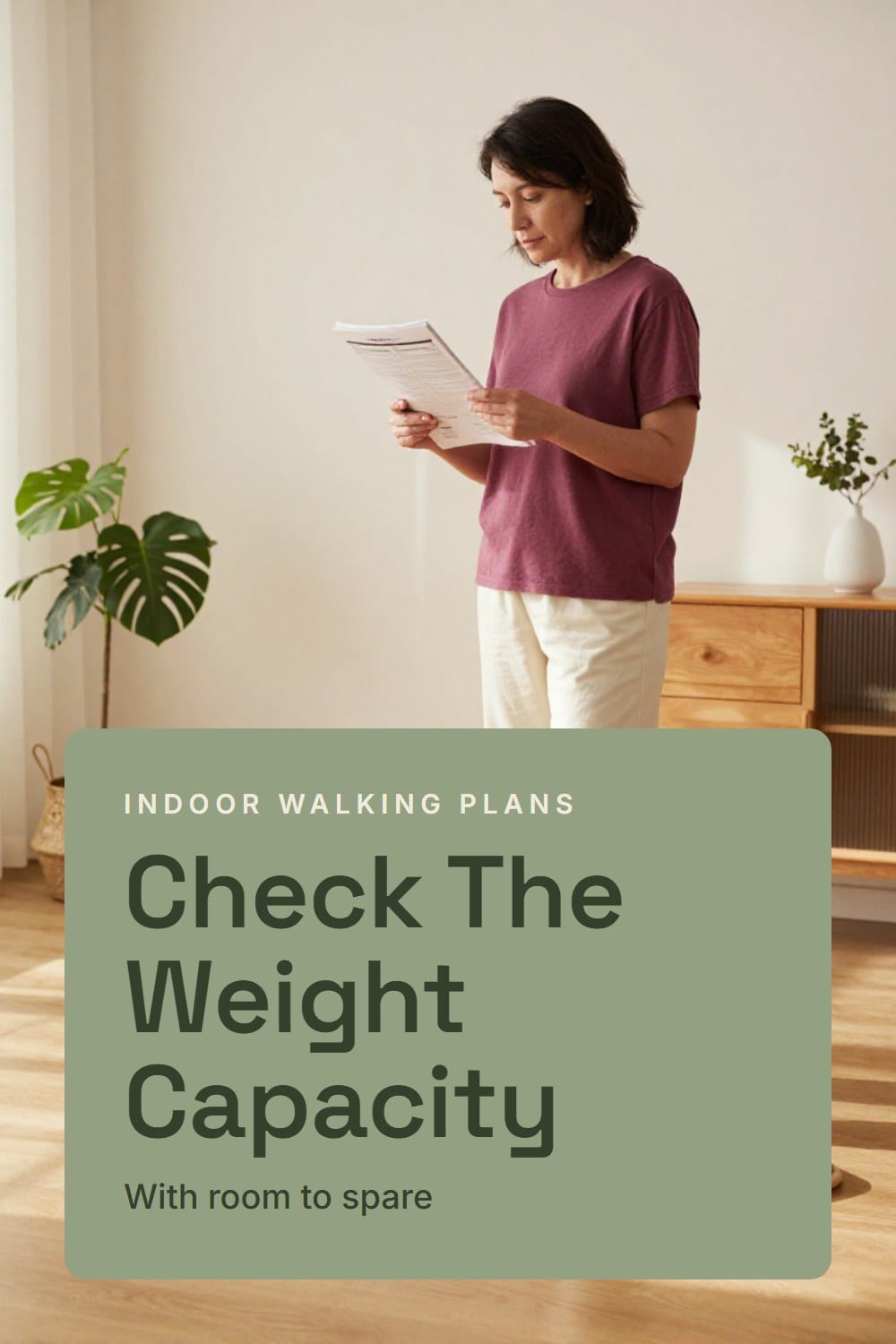
- Weight capacity, with room to spare. Look for a rated capacity comfortably above your own weight, not right at the edge of it. A machine running near its limit wears out faster and feels less stable underfoot, and stability's the entire point.
- A motor you can hold a conversation over. Quiet isn't a luxury feature here — it decides whether you actually use the thing during a work call or while someone naps down the hall. Where it's going to live matters almost as much as the machine itself: a pad in a finished basement or a garage gets away with more hum than one sitting directly above a bedroom or a home office with thin floors. Look for a stated decibel range, and read the reviews that specifically mention noise and flooring, not just the star rating.
- A low, wide deck. The lower the deck sits off the floor, the less awkward stepping on and off feels, and a wider belt gives your feet more room to land naturally. If your knees or hips are already cranky by afternoon, our low-impact walking modifications guide covers the same joint-friendly logic in more depth.
- A frame that doesn't wobble. Stand on the display model if you can, or read for the word 'sturdy' in real reviews if you can't. A handrail or a nearby wall to touch matters more than any other feature on this list for a lot of the women I hear from.
- A warranty and a real return window. A motor warranty measured in years, not months, and a return window measured in weeks, not days, tells you the company expects the product to hold up — and gives you room to change your mind once it's actually in your house.
You can check most of this without leaving your couch. A manufacturer's own spec page will usually state a weight rating and a decibel range if either exists at all, and the silence around a spec is useful information on its own. Customer photos on a listing tend to be more honest about real-world size and noise than the main product description ever is — look for the ones taken in an actual bedroom or office, not a showroom.
The honest picks: walking pads and shoes worth comparing
I'm not going to hand you a single 'best' pick, because the right walking pad depends on your space, your own weight-capacity comfort zone, and how much noise your household tolerates. A pad that's perfect for a quiet apartment with high ceilings can be the wrong choice for a shared house with a baby who naps at two in the afternoon. Below are honest starting points across pads and shoes — compare current listings, reviews and return policies before you decide, since details and availability shift, and none of these is the one true answer.
A quick comparison across pads and shoes. Tap through to see current details on each listing.
| What it is | Best for | Why I'd pick it |
|---|---|---|
| Compact Folding Walking Pad Folds flat for storage under a bed or in a closet, which matters if space is the reason you have not bought one yet. | Small rooms and daily desk-side steps | Folds flat for storage under a bed or in a closet, which matters if space is the reason you have not bought one yet. |
| Walking Pad with Incline A gentle incline raises the effort of the same slow pace, which tends to be kinder to achy knees than simply walking faster. | Adding effort without adding speed | A gentle incline raises the effort of the same slow pace, which tends to be kinder to achy knees than simply walking faster. |
| Higher-Capacity Walking Pad Worth comparing if the standard-width models on this list feel narrow, or you want more capacity margin than entry-level options offer. | A wider belt and a sturdier, more stable feel | Worth comparing if the standard-width models on this list feel narrow, or you want more capacity margin than entry-level options offer. |
| Supportive Cushioned Walking Shoes A walking-pad belt is firmer underfoot than grass or trail, so cushioning that felt like plenty outdoors can feel thin indoors. | All-day comfort on a firm walking-pad belt | A walking-pad belt is firmer underfoot than grass or trail, so cushioning that felt like plenty outdoors can feel thin indoors. |
| Wide-Fit Walking Shoes Worth trying if a standard width leaves a mark on your foot by evening — a shoe that pinches ends a walking habit faster than any machine will. | Wider feet or afternoon swelling | Worth trying if a standard width leaves a mark on your foot by evening — a shoe that pinches ends a walking habit faster than any machine will. |
| Non-Slip Indoor Walking Shoes A light indoor shoe with real tread beats socks on a belt, which can turn out more slick than a rug once it warms up. | Grip on a moving belt without going barefoot | A light indoor shoe with real tread beats socks on a belt, which can turn out more slick than a rug once it warms up. |
No prices here — Amazon requires them to be live, so click through to see what something costs today. Equipment helps; it is never the thing that makes a plan work.
The walking pad I would compare first
Start with the quietest, most compact option that clears your weight-capacity comfort zone with room to spare — you can always size up later.
See it on Amazon →The shoe upgrade most women skip
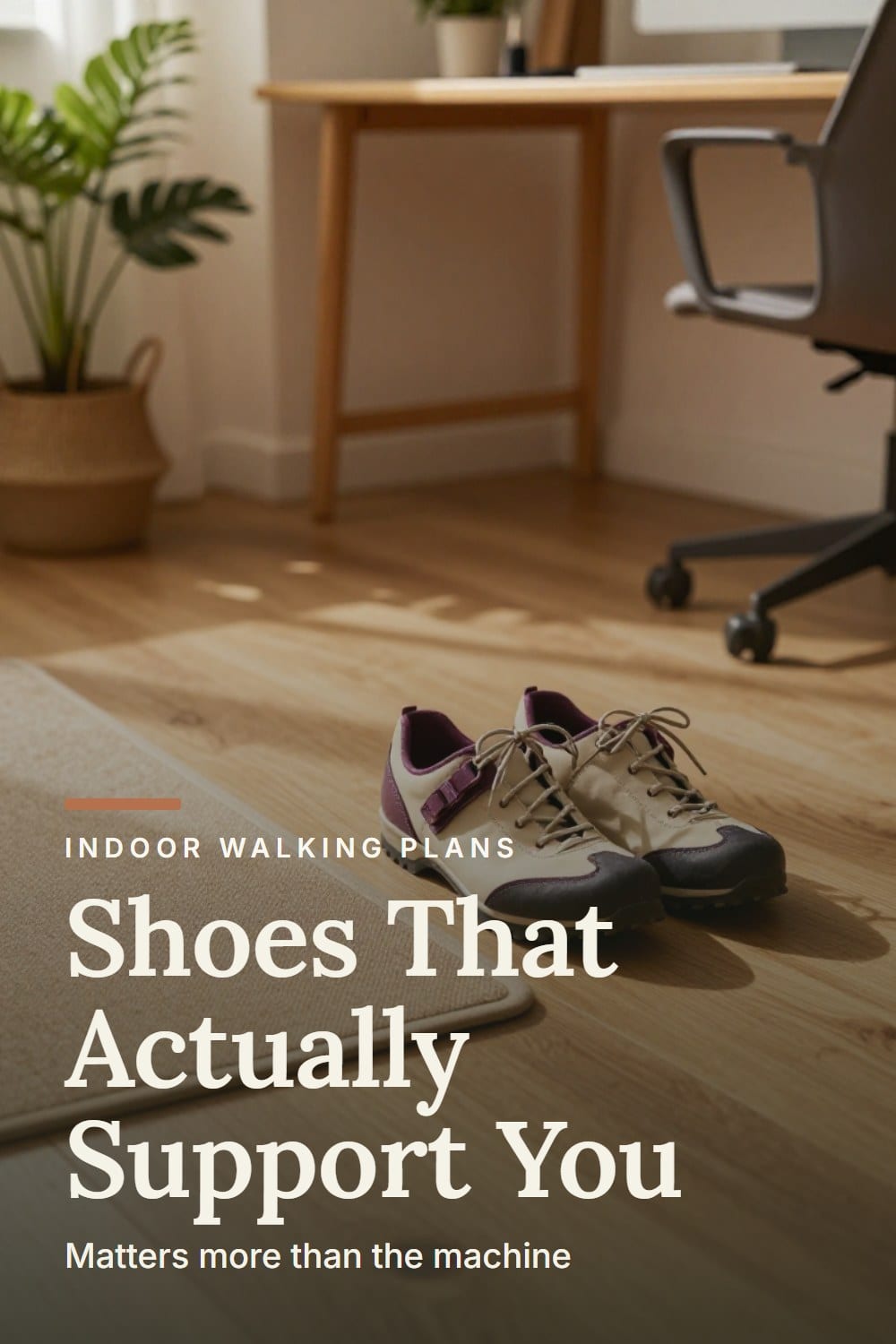
A supportive shoe with a wide toe box does more for how a walk feels than any single feature on the machine itself.
See it on Amazon →Here's what nobody puts in a product listing: a walking pad is quieter than a treadmill, but it isn't silent, and you'll feel the hum through the floor more than you'll ever hear it across the room. The first few days, staring at a screen while your legs do something else entirely feels a little strange — your brain keeps expecting you to either sit still or go somewhere, and doing both at once takes a few sessions to feel normal. Typing gets easy again long before video calls do; plenty of the women I hear from mute themselves out of habit for the first week, even on a quiet model. It also runs a bit warmer and louder after twenty straight minutes than it did in a showroom demo, which is one more reason the noise spec matters more than the color option ever will.
How to start on a walking pad without overdoing it
The same rule from the indoor walking plan applies here: start smaller than feels necessary, and add time before you add speed. A walking pad makes it tempting to turn the dial up simply because it's right there under your feet. Resist that for the first couple of weeks, the same way you'd pace yourself through the 28-day indoor walking challenge.
Posture matters more on a moving belt than it does on a sidewalk, mostly because it's easy to hunch toward a laptop screen without noticing. A few simple cues help with most of it, and you may feel the difference in your neck and shoulders within the first week.
Your first two weeks on a walking pad
Same idea as the indoor walking plan, adjusted for standing at a desk instead of a living room.
| Days | Time on the belt | Pace | Posture cue |
|---|---|---|---|
| Days 1–3Split it into two short sessions if fifteen minutes straight feels like a lot — there's no rule that says it has to happen in one block of time. | 10–15 minutes | Slow, an easy stroll | Stand tall — resist leaning on the console or the desk |
| Days 4–7 | 15–20 minutes | Same easy pace | Let your arms move naturally if you are not actively typing |
| Week 2If thirty minutes straight is too many, three tens count exactly the same — your legs don't know the difference. | 20–30 minutes, split across the day if easier | Still slow enough to talk or type | Shoulders back and eyes on the screen ahead of you, not down at your feet |
Please be careful
None of this is about diagnosing or promising anything for your body specifically — it's only about what the general research on walking supports, cited plainly below so you can check it yourself.
Where this comes from
I'd rather you checked than trusted me. Every claim about walking's general benefit above traces to one of these three.
- 1Walking: Trim your waistline, improve your health
Mayo Clinic · 2024
Supports: That regular brisk walking is associated with meaningful cardiovascular and metabolic benefit, whether it happens outdoors or on a machine indoors.
- 2Four Types of Exercise Can Improve Your Health and Physical Ability
National Institutes of Health — National Institute on Aging · 2023
Supports: That endurance activities like walking improve heart, lung and circulatory health, and support everyday physical ability as you age.
- 3Sole Searching: Learn About the Health Benefits of Walking
Cleveland Clinic · 2023
Supports: That walking at a comfortable, sustained pace is a legitimate, evidence-backed form of exercise on its own — not a lesser substitute for something harder.
Free, and printable
The 4-Week Indoor Walking Plan
The plan sign-up is not live yet — the mailing list is still being set up. In the meantime, email hello@strongandrooted.com and Diane will send it to you herself.
One email when there is something worth sending. Unsubscribe whenever you like.
Frequently asked questions
Do I need a walking pad to follow the plans on this site?
What weight capacity should I look for?
Will a walking pad wake up the rest of the house?
Do I need special shoes, or can I walk in socks?
A walking pad is a nice tool for a specific kind of day. It's not the thing that makes the walking count, and it's not required reading before you start. If you haven't already, the indoor walking plan for beginners over 40 is the actual place to begin — free, no equipment, no purchase required. Once you've got a few weeks behind you, the 28-day indoor walking challenge and walking in place at home are the next two places to go, with or without a machine under your desk. Whichever way you get there, the walking is what counts. The machine, if you decide to buy one, is only ever how you got there a little more often — and that's a perfectly good reason to own one, as long as it's the real one.
Free, and printable
The 4-Week Indoor Walking Plan
The plan sign-up is not live yet — the mailing list is still being set up. In the meantime, email hello@strongandrooted.com and Diane will send it to you herself.
One email when there is something worth sending. Unsubscribe whenever you like.
Written by
Diane Marsh
At 49 I was tired, achy, sleeping badly, and being told to do more cardio and eat less — which was making all of it worse. I started walking. Fifteen minutes, indoors, in socks. Three years later I am stronger than I was at forty. I write down exactly what I did, cite the research where it exists, and admit where it doesn't.
Diane is not a doctor, a physical therapist, or a dietitian. She is a woman who rebuilt her own strength after perimenopause, reads the research carefully, cites it, and says so when nobody actually knows.
Strong & Rooted is a participant in the Amazon Services LLC Associates Program, an affiliate advertising program designed to provide a means for sites to earn advertising fees by advertising and linking to Amazon.com. As an Amazon Associate I earn from qualifying purchases. If you click a link and buy something, I may receive a small commission at no additional cost to you. I recommend only equipment I have used myself or would hand to a friend, and commission never decides the order of a list. Prices are never shown here because Amazon requires displayed prices to be live — click through to see what something costs today.
Keep reading
Everything this site knows about walking after 40, in one place — what actually changes in your body, the honest version of every trending method, and exactly which article to read next for where you are right now.
Is Walking Enough for Your Bones and Joints After 40?Walking really is linked to stronger hips — the research on this is genuinely encouraging. But if bone density and joint health are what you're after, walking is the first chapter, not the whole book. Here's the honest, cited version of what to add.
What Walking Really Does for a Midlife Metabolism (An Honest Answer)You've probably been told a walk will change everything menopause does to your body. It won't, not on its own — but here's the honest mechanism instead: what actually changes after 40, why it matters for your heart and blood sugar rather than your mirror, and what genuinely helps more than walking alone.